
Commercial freezer supply pressure eases after steel price swings
After months of steel price volatility, supply pressure on the commercial freezer market is beginning to ease, giving buyers across foodservice and processing operations more room to plan equipment upgrades. For procurement teams comparing a kitchen prep table, commercial sink unit, and other kitchen preparation equipment, this shift may improve availability, pricing stability, and decision-making confidence.
That change matters across the wider kitchen equipment industry. Commercial freezers are not isolated purchases; they affect cold-chain continuity, kitchen workflow, food safety, energy planning, and capital budgeting. When raw material pressure starts to soften, operators, sourcing managers, and business leaders can revisit delayed projects with clearer visibility on lead time, specification, and total cost.
For restaurants, hotels, central kitchens, and food processing sites, the current market is less about chasing the lowest upfront quote and more about making a stable procurement decision. Buyers now have a better opportunity to compare freezer capacity, insulation quality, compressor configuration, workspace integration, and after-sales support alongside related kitchen preparation equipment.
Why easing steel pressure changes the commercial freezer market
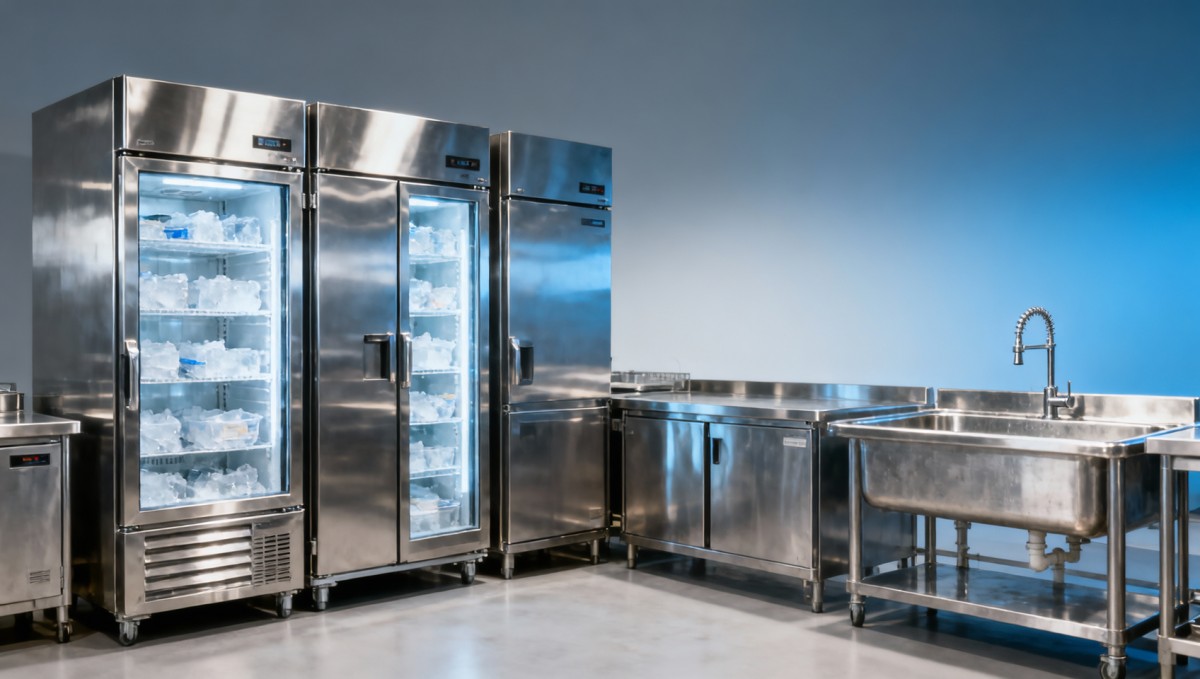
Steel is a core input in commercial freezer cabinets, internal liners, shelving systems, structural frames, and many matching stainless kitchen products. When steel prices swing sharply for 3 to 6 months, freezer manufacturers often face unstable production costs, tighter inventory control, and less predictable quotation validity. In many cases, quote windows shrink to 7 to 15 days, making procurement planning harder for buyers.
As raw material pressure begins to ease, manufacturers can usually stabilize purchasing plans, improve factory scheduling, and reduce emergency sourcing. This does not mean prices will fall overnight, but it often means fewer abrupt revisions, better stock visibility, and more consistent delivery commitments. For projects involving 5 to 20 units, that stability can significantly reduce planning friction.
This improvement is especially relevant in the broader kitchen equipment sector, where commercial freezers are often procured together with prep tables, sinks, storage racks, and food handling stations. A more stable steel market can support bundled sourcing strategies, allowing procurement teams to negotiate better coordination across multiple product categories rather than treating each item as a separate cost risk.
For information researchers and decision-makers, the key signal is not simply “steel is cheaper.” The more important signal is that supply pressure is easing enough to make comparison, budgeting, and project timing more reliable. This is useful when planning kitchen renovations, cold-room expansion, or replacement cycles that were previously delayed by uncertain pricing.
Key market effects buyers should watch
- Quotation validity may extend from around 7 days to 15 to 30 days in some routine projects.
- Lead times for standard upright or undercounter freezer models may move closer to a 2 to 4 week range instead of highly variable schedules.
- Procurement teams can compare cabinet material thickness, insulation density, and internal layout with less pressure to rush a purchase.
- Bundled orders covering freezer units and preparation equipment may become easier to coordinate within one shipment cycle.
Common misunderstanding
A softer raw material environment does not automatically mean every supplier offers lower pricing. Final freezer cost still depends on compressor brand tier, refrigerant system design, controller type, door count, shelf configuration, and destination logistics. Buyers should therefore focus on cost structure transparency rather than expecting uniform market-wide discounts.
How procurement teams should reassess freezer selection now
When supply pressure eases, the best use of the opportunity is a more disciplined technical review. Instead of buying based only on cabinet size or immediate availability, procurement teams should revisit operating temperature range, usable net volume, ambient condition performance, energy demand, and service access. In real kitchens, these details influence cost for 3 to 8 years, not just on delivery day.
A restaurant may prioritize compact footprint and fast door access, while a food processing facility may focus on temperature consistency, load recovery, and sanitation. In hotels and central kitchens, a freezer is often part of a process chain involving receiving, washing, prep, holding, and dispatch. That is why freezer evaluation should be aligned with kitchen preparation equipment rather than handled as a standalone decision.
Operators and maintenance staff should also be included early. A unit that looks efficient on paper may create daily friction if shelf spacing is impractical, drain access is poor, or cleaning takes 20 minutes longer per cycle. Over a 12-month period, those operational inefficiencies can outweigh a modest purchase-price difference.
The table below summarizes practical selection factors for different buyer priorities in commercial freezer procurement.
The main takeaway is that the right freezer is defined by use intensity and kitchen process, not just by capacity. For many B2B buyers, a better decision comes from linking freezer performance to adjacent equipment such as a kitchen prep table, commercial sink unit, and staging area layout.
A 4-point procurement review before issuing orders
- Confirm actual holding demand by product type, not only total volume. Frozen meat, pastry, seafood, and prepared meals often require different storage logic.
- Check installation conditions including ambient temperature, ventilation clearance, floor drainage, and power compatibility.
- Review service response expectations, especially if downtime beyond 24 to 48 hours would interrupt production.
- Compare total delivered value, including accessories, freight coordination, and commissioning support.
Commercial freezer specifications that matter more than short-term price swings
Price movements attract attention, but specification discipline protects long-term value. In commercial freezer purchasing, several technical points have a bigger impact than a temporary steel fluctuation. These include insulation quality, temperature uniformity, door sealing, refrigeration system matching, and ease of cleaning. If any one of these is overlooked, a lower purchase price can quickly become a higher operating cost.
For many commercial applications, a freezer operating range of about -18°C to -22°C is common, but what matters is not just the setpoint. Buyers should ask how the cabinet performs during repeated door openings, peak production hours, or 30°C to 43°C ambient kitchen conditions. A unit that recovers slowly may compromise product quality and increase compressor workload.
Material quality also deserves closer review. Stainless steel grade, panel thickness, shelf load capability, and hinge durability all affect lifespan in high-use environments. For example, kitchens that load dense frozen inventory need shelving and base structure designed for regular heavy-duty use, not just occasional storage. The practical difference appears over 2 to 5 years of operation.
The comparison below highlights specification areas buyers should prioritize when evaluating commercial freezer offers.
The table shows why technical clarity is often more valuable than chasing small price changes. A freezer used 10 to 16 hours per day in a busy service environment must be evaluated for durability and operating fit, not only invoice amount.
Specification mistakes that often increase cost later
- Choosing gross volume without checking usable internal storage after shelves and airflow space are considered.
- Ignoring ventilation clearance, which can reduce efficiency and raise service frequency.
- Selecting a cabinet for light-duty retail use in a back-of-house kitchen with high door-opening frequency.
- Overlooking cleaning design, especially in sites with daily washdown or strict sanitation procedures.
Where preparation equipment affects freezer performance
Freezers work best when surrounding kitchen preparation equipment supports efficient flow. If receiving, washing, prep, and loading points are poorly arranged, doors stay open longer, product handling takes more steps, and temperature stability suffers. A layout improvement of even 1 to 2 fewer handling steps per batch can reduce congestion and support better freezer use.
Lead times, bundled sourcing, and risk control in kitchen equipment projects
As supply pressure eases, many buyers will consider placing combined orders rather than purchasing freezers one by one. This approach can work well when a project also requires a kitchen prep table, commercial sink unit, worktops, storage equipment, or food processing support stations. Bundled sourcing can improve shipment coordination, reduce duplicate communication, and simplify installation scheduling.
However, bundled procurement only delivers value if the project timeline is managed carefully. Standard freezer models may ship in roughly 2 to 4 weeks under normal production conditions, while custom stainless workstations or sink configurations may require 3 to 6 weeks depending on fabrication detail. If those timelines are not aligned, the project may still face handover delays.
For procurement managers, the right response is a milestone-based sourcing plan. Instead of waiting for every item to be finalized at once, teams can lock core freezer specifications first, then align related kitchen preparation equipment by installation sequence. This approach is useful in renovations where downtime must be limited to a narrow window, such as 48 to 72 hours.
The table below outlines common project risks and practical controls for commercial freezer and related kitchen equipment purchases.
The practical lesson is simple: easing supply pressure creates better buying conditions, but risk control still depends on disciplined project coordination. In kitchen equipment procurement, timing, specification control, and installation sequencing often matter as much as price.
A workable 5-step sourcing process
- Map workflow and define equipment interaction points.
- Confirm freezer capacity, external dimensions, and utility conditions.
- Align related stainless and prep equipment by installation sequence.
- Review delivery, inspection, and commissioning milestones.
- Set maintenance responsibility, training scope, and spare part expectations.
Practical guidance for operators, buyers, and business decision-makers
Different stakeholders view the same commercial freezer purchase from different angles. Operators care about access, cleaning, and day-to-day reliability. Procurement teams focus on price validity, specification clarity, and delivery confidence. Business leaders are more concerned with lifecycle value, expansion flexibility, and whether the equipment supports higher output without creating new bottlenecks.
For operators, the best time to influence a purchase is before the order is finalized. Their input on shelf height, tray movement, door orientation, and cleaning routine can prevent years of avoidable inconvenience. A 10-minute review by the people who use the equipment every day can be more valuable than multiple rounds of quote comparison based only on headline price.
For procurement personnel, the current market improvement is an opportunity to ask better questions. Instead of only requesting discounts, ask suppliers to clarify standard lead time, replacement part access, service responsibility, and integration with other kitchen equipment. When a supplier can support both freezer units and preparation equipment, communication and accountability are often easier to manage.
For decision-makers, the strategic issue is timing. If a project was postponed solely because material volatility made budgeting difficult, the easing supply environment may justify restarting evaluation. This is particularly relevant for businesses planning capacity growth over the next 6 to 12 months or upgrading older freezers that are increasingly costly to maintain.
FAQ: common questions in the current buying cycle
How long is a typical commercial freezer delivery time now?
For standard units, many projects can expect around 2 to 4 weeks, while custom configurations may require 4 to 8 weeks depending on material allocation, fabrication detail, and shipping route. Buyers should still confirm quote validity and production slot timing before issuing purchase orders.
Should buyers wait longer for lower prices?
Waiting can help only if your project has no operational urgency. In many commercial kitchens, the cost of inefficiency, unplanned maintenance, or weak storage capacity can exceed any marginal savings from delaying a purchase by 30 to 60 days. A better approach is to secure specification clarity and delivery reliability now.
What should be checked when buying a freezer with other kitchen equipment?
Check installation sequence, site dimensions, drainage, power conditions, workflow adjacency, and acceptance criteria for each product group. This is especially important when combining a commercial freezer with a kitchen prep table and commercial sink unit in one project package.
Which buyers benefit most from the easing supply situation?
The biggest beneficiaries are businesses managing replacement cycles, kitchen expansion, or multi-item procurement. Restaurants, hotels, central kitchens, and food processors that need 3 or more coordinated equipment categories can often gain the most from improved supply visibility.
The commercial freezer market is becoming easier to navigate as steel-related supply pressure moderates, but smart purchasing still depends on structured evaluation. Buyers who connect freezer selection with workflow, kitchen preparation equipment, realistic lead times, and after-sales planning are more likely to secure lasting value instead of short-term savings alone.
If you are reviewing freezer replacement, planning a kitchen upgrade, or sourcing a bundled solution that includes prep tables, sink units, and other commercial kitchen equipment, now is a practical time to compare options in detail. Contact us to discuss your application, get a tailored equipment recommendation, and explore a procurement plan built around your operating needs.
Popular Tags
Kitchen Industry Research Team
Dedicated to analyzing emerging trends and technological shifts in the global hospitality and foodservice infrastructure sector.
Industry Insights
Join 15,000+ industry professionals. Get the latest market trends and tech news delivered weekly.
No spam. Unsubscribe anytime.

Contact With us
Contact:
Anne Yin (Ceramics Dinnerware/Glassware)
Lucky Zhai(Flatware)