
Glass Honey Jar Labeling Space Can Limit Shelf Appeal
Limited labeling space on a glass honey jar can weaken shelf appeal, reduce brand visibility, and affect buying decisions. For buyers, operators, and decision-makers exploring kitchen innovation and packaging efficiency, the challenge goes beyond design. From a glass jam jar to a porcelain serving dish, smart product presentation matters in today’s competitive market.
In kitchen equipment and foodservice operations, packaging is not an isolated visual issue. It affects storage efficiency, dispensing accuracy, menu presentation, and even compliance communication. A honey jar with a narrow label panel may look elegant, but if key information becomes hard to read or branding gets compressed, the product can lose impact on retail shelves, hotel breakfast stations, and specialty food counters.
For information researchers, operators, procurement teams, and business decision-makers, the real question is how to balance container aesthetics, labeling space, operational usability, and product visibility. The answer often lies in choosing the right packaging format, supporting kitchen display tools, and workflow-friendly serving solutions that connect packaging decisions with broader kitchen efficiency goals.
Why Labeling Space Matters in Food Presentation and Kitchen Operations
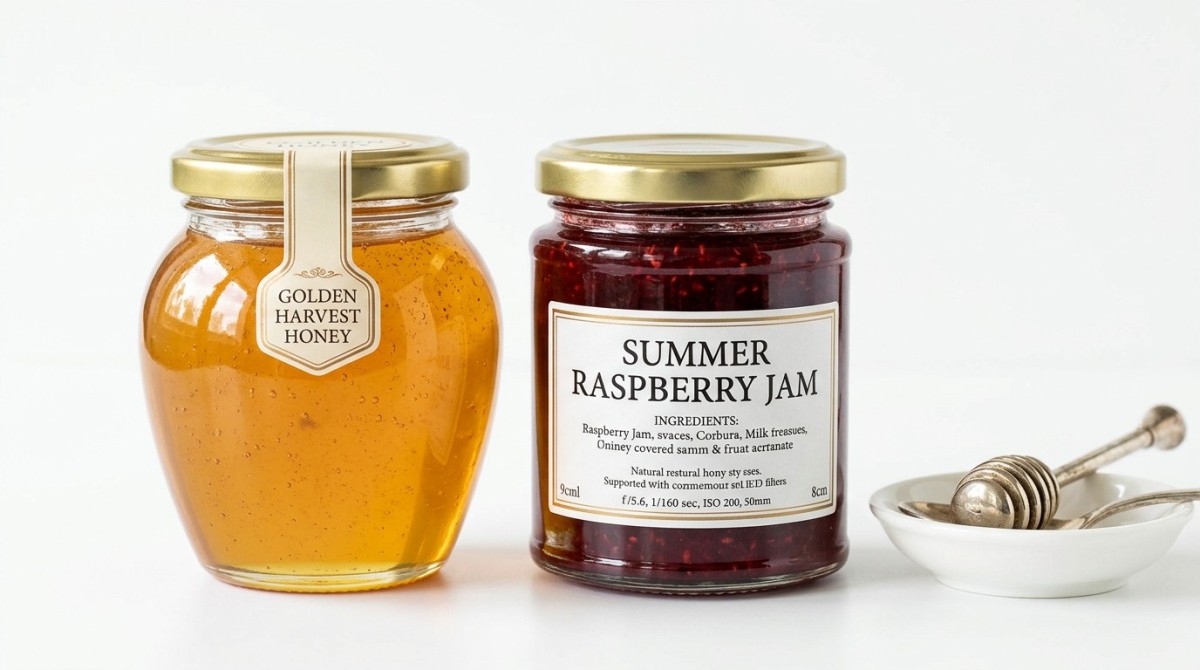
A glass honey jar often has curved shoulders, a small front-facing panel, and limited flat surface area. In practical terms, this can reduce the usable label zone to 35%–55% of the container body, depending on jar diameter and shoulder angle. When brands need to include product name, ingredients, origin, usage notes, barcode, and batch information, the available space becomes a real operational constraint.
This matters in commercial kitchens and hospitality environments because food containers are part of the service system. A mislabeled or hard-to-read jar slows down operators during peak periods, especially in breakfast buffets, dessert stations, and back-of-house prep zones. Even a 3–5 second delay per retrieval can add up when staff handle 100 or more items in one shift.
Limited labeling space also affects shelf appeal. On retail shelves, customers usually scan front-facing products within 2–4 seconds. If the brand name is too small, the flavor is unclear, or the premium message is lost in a cramped layout, product differentiation weakens. This is especially important for honey, jam, syrups, and condiment lines competing in crowded specialty food categories.
For kitchen equipment buyers, the issue expands further. Packaging format influences how jars fit into storage racks, heated display zones, condiment organizers, and service trays. A beautifully shaped jar may support premium positioning, but if it does not work efficiently with labeling, stacking, and access, it can increase handling complexity rather than improve service value.
Key pressure points for buyers and operators
- Small label panels reduce readable font size, often below the practical 6–8 pt range for quick service identification.
- Curved surfaces can create wrinkling, edge lift, or misalignment during automated or semi-automatic labeling.
- Premium glass shapes may look attractive but provide weaker compatibility with standard label applicators and shelf-facing systems.
- Insufficient front-panel messaging can shift critical content to side or back labels, lowering first-glance conversion.
The table below shows how container shape can influence both labeling efficiency and foodservice usability across common packaging and serving scenarios.
A useful takeaway is that packaging and serving formats should be evaluated together. A round honey jar may support premium merchandising, while a straight-wall jar or an integrated serving dish system may work better when readability, speed, and front-of-house consistency are the top priorities.
How Packaging Decisions Connect to Kitchen Equipment Selection
In the kitchen equipment industry, packaging choices influence more than appearance. They affect dispenser compatibility, storage density, portion control, cleaning routines, and labor flow. For example, a 250 g honey jar and a 500 g honey jar may use similar branding, but their footprint in racks, warming shelves, and buffet stations creates very different operational outcomes.
Commercial kitchens increasingly rely on integrated systems. This includes condiment holders, jar organizers, heated display units, digital labeling support, and food-safe serving accessories. If the original glass honey jar has limited labeling space, operators often compensate with secondary tools such as clip-on tags, tabletop product signs, color-coded lids, or QR-linked menus. These additions should be planned early, not treated as last-minute fixes.
Procurement teams should also consider whether the packaging supports automation. Semi-automatic labelers generally work more consistently with straight cylindrical surfaces and tolerance variation within about ±1.5 mm. Highly decorative jars with deep curvature can increase mislabel rates, rework time, and line stoppages. In medium-volume food production, even a 2%–4% application error rate can become costly over several thousand units.
For decision-makers, the broader objective is standardization. A unified packaging logic across honey, jam, sauce, and condiment products improves shelf appearance and supports more predictable storage and service workflows. This matters in hotels, bakery chains, central kitchens, and specialty retailers where product variety is high but display space is limited.
Selection factors that should be reviewed together
- Container geometry: check flat label area, shoulder curvature, and stable stacking performance.
- Equipment compatibility: confirm suitability for label applicators, conveyors, shelving, and condiment display accessories.
- Information hierarchy: reserve visible space for product name, flavor, net content, and quick-use instructions.
- Cleaning and reuse needs: if jars enter service stations, evaluate residue control, lid handling, and dishwasher tolerance where relevant.
- Front-of-house coordination: ensure the jar works visually with trays, porcelain dishes, and buffet presentation systems.
Practical equipment implications
A narrow-label jar may still perform well if supported by the right accessories. In a hotel breakfast setting, combining compact honey jars with angled risers, acrylic label holders, and portion-control spoons can improve both visibility and service cleanliness. In a retail environment, shelf-edge strips and secondary signage may be enough to compensate for reduced on-pack communication.
The point is not to avoid elegant packaging. It is to build an equipment and display system around it. When procurement teams align packaging with kitchen tools and merchandising fixtures, the product works better across storage, handling, and customer interaction stages.
Choosing Between Glass Jars, Serving Dishes, and Hybrid Display Solutions
Not every product needs to communicate everything on the jar itself. In many foodservice settings, especially in hotels, cafés, and bakery counters, a hybrid approach works better. The product may arrive in a glass honey jar for storage and food safety control, then move into a porcelain serving dish or a table-ready dispenser supported by separate identification signage.
This approach is useful when brand storytelling, allergen clarity, and usage instructions exceed available label space. It is also valuable when jars are very small, such as 45 ml to 120 ml mini formats used in tasting menus, breakfast service, or gift assortments. In these cases, expecting full communication on a small curved label is unrealistic.
However, hybrid display systems need discipline. If operators transfer honey or jam from the original container into serving dishes without a clear identification process, traceability and consistency can suffer. That is why many kitchens use a 2-step rule: keep the original labeled packaging available in the back-of-house area, and place a matching front-of-house label card or product marker with each serving unit.
The comparison below can help buyers decide which route best fits their service model, product range, and presentation goals.
For most B2B buyers, the hybrid route offers the best flexibility. It protects the premium look of the glass jar while solving visibility gaps with structured support materials. It is especially suitable when the same product moves across 2 or 3 channels, such as retail, hospitality, and gifting.
When a hybrid solution is usually worth it
- The front label cannot clearly show brand, flavor, and net content at one glance.
- Operators need faster recognition in service windows or self-serve stations.
- The same product is sold both packaged and plated.
- You manage more than 10 SKUs and need a scalable visual identification system.
In purchasing terms, that means budgeting not only for the container, but also for serving hardware, identification accessories, and replacement components. A slightly higher initial system cost can reduce confusion, improve presentation quality, and lower relabeling or manual explanation needs over time.
Procurement Criteria, Risk Control, and Implementation Steps
A common mistake in packaging procurement is evaluating the jar alone without testing it in the full service environment. Buyers should assess at least 4 dimensions: label readability, handling efficiency, equipment compatibility, and display consistency. Reviewing only cost per unit can lead to hidden downstream expenses in labor, relabeling, breakage management, or customer confusion.
A practical pilot process usually takes 7–14 days. During this period, teams can test sample jars in storage racks, buffet lines, shelves, and cleaning routines. They should also verify whether the selected label material performs under chilled, ambient, or slightly warm conditions. Condensation, oil contact, and repeated handling can all affect label performance.
Risk control should include visibility checks at 1 meter and 2 meters, barcode scanning trials, and fill-to-display stability review. For foodservice buyers, it is also useful to observe whether the jar opening supports clean spoon access or controlled dispensing. A jar that looks good but creates sticky rims and slow handling can weaken the customer experience.
The implementation checklist below helps procurement teams connect packaging aesthetics with real kitchen and service requirements.
5-step implementation flow
- Define the service channel: retail shelf, buffet, café counter, gift pack, or mixed use.
- Measure effective label area and identify mandatory front-facing information.
- Test compatibility with racks, dispensers, trays, and serving accessories.
- Run a short pilot with 20–50 units to observe handling and visibility issues.
- Finalize support tools such as shelf tags, porcelain dishes, or table cards where needed.
Common procurement risks
- Choosing a decorative jar shape before confirming labeling machine tolerance.
- Underestimating the need for secondary signage in hospitality settings.
- Ignoring operator feedback on grip, lid opening torque, and refill speed.
- Using one packaging logic across retail and dine-in channels without adaptation.
For enterprise decision-makers, the best purchasing outcome usually comes from cross-functional review. Packaging, kitchen operations, merchandising, and procurement should align early. That reduces redesign cycles, supports smoother launches, and helps ensure the final presentation system works as intended across multiple use cases.
FAQ for Buyers, Operators, and Decision-Makers
How do I know if a glass honey jar has too little labeling space?
A practical warning sign is when the front panel cannot show the product name, flavor or variety, and net content clearly at one glance. If your readable area falls below roughly 40% of the body surface or forces key text below 6 pt for compact formats, visibility is likely too limited for efficient shelf communication.
Is a porcelain serving dish a replacement for labeled packaging?
Not fully. A porcelain serving dish improves table presentation and buffet aesthetics, but it should complement rather than replace the original labeled container. In most foodservice workflows, the original package supports back-of-house identification, while the serving dish requires a separate product card, table sign, or coded marker for front-of-house clarity.
What should procurement teams prioritize first: jar design or equipment compatibility?
They should be evaluated together, but equipment compatibility should be checked before final design commitment. A jar that causes labeling errors, poor shelf fit, or awkward dispensing can generate recurring costs. In most B2B settings, a 5% gain in workflow efficiency is more valuable over time than a purely decorative packaging advantage.
What is a reasonable pilot size before full rollout?
For small and medium commercial use, a pilot of 20–50 units is usually enough to test label readability, handling, stacking, and display response. For multi-site hospitality groups or specialty retail chains, a broader trial across 2–3 locations over 1–2 weeks provides more reliable feedback before final purchasing.
Limited labeling space on a glass honey jar is not just a packaging design issue. It affects visibility, operator speed, food presentation, and procurement efficiency across retail and kitchen environments. The best solution is rarely a single container choice. More often, it is a coordinated system that combines suitable jars, readable identification, compatible kitchen equipment, and presentation tools that match the service channel.
If you are evaluating packaging, serving accessories, or kitchen display solutions for honey, jam, condiments, or specialty foods, now is the time to review the full workflow. Contact us to discuss your application, get a tailored solution, and explore equipment and presentation options that improve both shelf appeal and operational performance.
Popular Tags
Kitchen Industry Research Team
Dedicated to analyzing emerging trends and technological shifts in the global hospitality and foodservice infrastructure sector.
Industry Insights
Join 15,000+ industry professionals. Get the latest market trends and tech news delivered weekly.
No spam. Unsubscribe anytime.

Contact With us
Contact:
Anne Yin (Ceramics Dinnerware/Glassware)
Lucky Zhai(Flatware)