
What makes a commercial sink unit easier to clean daily?
A commercial sink unit that is easier to clean daily can significantly improve hygiene, workflow, and labor efficiency in busy kitchens. For buyers comparing kitchen preparation equipment, from a kitchen prep table and kitchen storage cabinet to a glass washer machine and commercial freezer, cleanability is a practical feature that directly affects operating costs, food safety, and long-term performance.
In restaurants, hotels, central kitchens, and food processing facilities, the sink area is one of the highest-use zones in the entire operation. It may handle food prep, utensil washing, handwashing support, and waste water management for 8–16 hours per day. When a commercial sink unit is difficult to clean, soil buildup, standing water, and hidden bacteria risks increase quickly, especially during peak service periods.
For operators, an easy-to-clean sink means fewer minutes lost in every shift. For procurement teams, it means lower labor input, simpler sanitation compliance, and more predictable maintenance. For business decision-makers, it supports food safety goals and protects equipment value over a 5–10 year usage cycle. The key question is not just which sink looks durable, but which design reduces daily cleaning effort without compromising capacity or workflow.
Why daily cleanability matters in a commercial sink unit
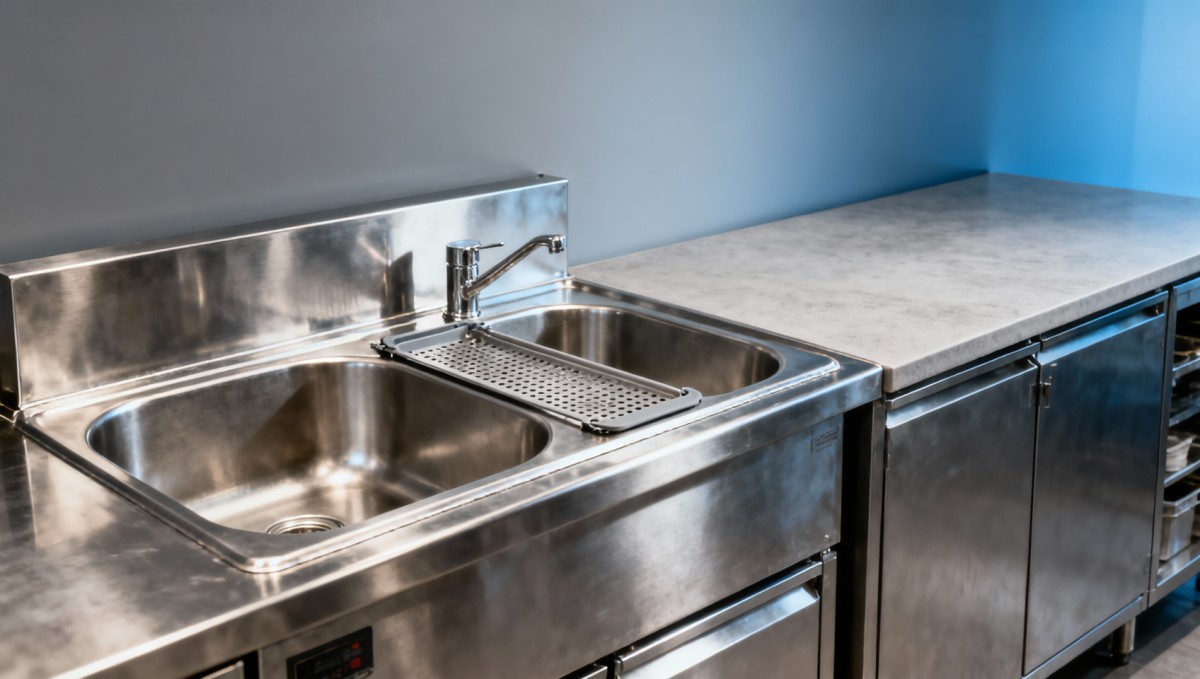
A commercial sink unit is exposed to grease, food particles, detergent residue, mineral deposits, and moisture every day. In a high-volume kitchen, even a small design flaw can multiply cleaning time by 10–20 minutes per shift. Across a 30-day operating month, that can add up to 5–10 extra labor hours for a single workstation.
Daily cleanability is closely tied to food safety. If corners trap debris, welds are rough, or drainage is slow, contamination risk rises. This is especially important in kitchens that separate raw meat, seafood, vegetables, and ready-to-eat items. A sink that can be rinsed, wiped, and sanitized in 3–5 steps helps teams maintain cleaner routines during busy service windows.
It also affects workflow. In many commercial kitchens, the sink zone sits near a kitchen prep table, storage shelves, or dishwashing equipment. If staff need to dismantle parts, scrub awkward seams, or move around splash-heavy areas, the station becomes a bottleneck. Easier cleaning supports smoother movement and better zoning between prep, wash, and storage activities.
From a purchasing perspective, easy cleaning is not a cosmetic feature. It influences labor cost, sanitation audit readiness, and service life. A slightly higher initial investment in a better-designed unit may reduce routine cleaning time by 15%–30%, which can be meaningful in multi-site restaurant groups or hotel kitchens managing several wash stations.
Operational impact across different kitchen environments
Different operations use sink units differently. A café may need compact rinsing and low splash. A hotel kitchen may require multi-compartment washing with higher daily turnover. A food processing room may prioritize strict hygiene zoning and smooth, washable surfaces. The same sink type does not fit every cleaning routine.
- Restaurants often focus on speed, grease control, and resistance to repeated detergent use.
- Hotels usually need larger bowl volume, accessory integration, and stable drainage under continuous use.
- Food processing facilities often prioritize hygienic design, fewer dirt traps, and easier end-of-shift sanitation.
- Central kitchens may evaluate cleanability together with throughput, staff training simplicity, and cross-station consistency.
Design features that make a sink easier to clean every day
The easiest commercial sink units to clean are not defined by one feature alone. Cleanability usually comes from a combination of material choice, fabrication quality, drainage design, and station layout. Buyers should examine how all these details work together under daily operating pressure.
The first essential factor is surface quality. Stainless steel remains the most common choice because it is durable, corrosion-resistant, and compatible with routine cleaning chemicals. In practice, smoother finishes are easier to wipe down than rough or irregular surfaces. A well-finished sink basin reduces residue adhesion and simplifies end-of-shift cleaning.
The second factor is geometry. Rounded internal corners are easier to rinse and sanitize than sharp 90-degree angles. Bowl transitions, backsplashes, and drain areas should allow water and debris to move freely. A sink with proper slope and fewer hidden creases can cut down manual scrubbing significantly.
The third factor is assembly detail. Poor weld polishing, exposed fasteners, and hard-to-reach undersides create dirt traps. In contrast, seamless or smoothly finished joints make routine cleaning faster and more consistent. This matters even more in kitchens with 2–3 cleaning cycles per day or strict visual hygiene checks.
Key design points to evaluate
Before comparing prices, it helps to check the practical details below. These are the features most operators notice during the first 30–60 days of use.
- Rounded bowl corners with smooth transitions instead of tight, sharp corners.
- Adequate drain slope so water does not remain in the basin after washing.
- Polished welds and sealed joints that do not trap grease or food residue.
- Raised backsplash, commonly 100–150 mm, to reduce wall contamination.
- Open-frame or accessible undershelf areas that allow floor and leg cleaning.
- Removable strainers or drain components that can be rinsed in under 1–2 minutes.
Comparison of common sink design choices
The table below shows how common structural choices affect daily cleaning effort in commercial kitchens.
In practical terms, the most valuable cleaning features are usually the least visible during a showroom review. Corner radius, drain angle, and weld quality may not change the purchase decision at first glance, but they often determine whether the unit remains easy to sanitize after 6–12 months of real use.
Materials, dimensions, and configurations buyers should review
Choosing an easy-to-clean commercial sink unit also requires attention to size and configuration. A sink that is too small creates splashing and congestion. A sink that is too large for the workflow may leave unused wet areas that are harder to maintain. Bowl depth, drain placement, and compartment count should match the actual washing or prep task.
Single-bowl units are often suitable for limited-space applications or targeted prep zones. Double- and triple-compartment sink units are common where washing, rinsing, and sanitizing must be separated. In operations with medium to high throughput, a multi-bowl unit can improve process control, but only if spacing and access remain easy to clean.
Material thickness also matters. In many commercial applications, buyers compare stainless steel grades and gauge ranges to balance durability and cost. A more robust structure helps prevent distortion over time, which is important because warped surfaces, loose edges, and unstable frames become cleaning problems as much as mechanical ones.
Accessories should be selected carefully. Drainboards, pre-rinse fittings, splash guards, and faucet assemblies can improve utility, but each extra component adds a cleaning surface. The best configuration is not the one with the most attachments; it is the one that delivers the required function with manageable sanitation effort.
Typical specification ranges
The table below outlines common specification ranges that buyers often review when balancing daily cleanability, capacity, and kitchen layout.
These are not fixed rules for every project, but they provide a practical starting point. The best results come when sink dimensions are matched with actual utensils, washing volume, operator reach, and nearby equipment such as a glass washer machine or commercial freezer access route.
Questions procurement teams should ask suppliers
- Are the welds fully polished and visually smooth in bowl corners and edge joints?
- Can the drain strainer, waste fitting, or accessories be removed without tools?
- How much cleaning clearance is needed around the rear, side, and underside areas?
- Will the sink be used for prep, wash, or both, and is the surface layout designed accordingly?
- Does the configuration reduce splash onto nearby prep tables, storage cabinets, or walkways?
Common cleaning problems and how better sink design prevents them
Many commercial sink cleaning issues are predictable. The most common problems include slow drainage, residue buildup at seams, standing water near the drain, splash contamination on walls, and dirt accumulation around the legs or undershelf. These problems may seem minor individually, but together they increase labor time and reduce sanitation consistency.
A frequent mistake is choosing a sink based only on bowl count or overall footprint. In reality, a triple sink with poor drain design may take longer to clean than a well-built double sink. Similarly, a low-cost unit with rough finishing may require aggressive scrubbing after only a few weeks of heavy use.
Another issue is accessory overload. Operators sometimes request side shelves, overshelves, faucets, spray arms, and integrated bins without considering daily wipe-down time. Every added component should justify its cleaning burden. If a feature saves 30 seconds in operation but adds 5 minutes to cleaning, it may not be worth the trade-off.
Kitchen layout can also create hidden hygiene problems. If the sink is installed too close to a wall, prep zone, or refrigeration door swing, staff cannot reach critical surfaces. Even the best sink design loses value when placement prevents proper access for cleaning cloths, brushes, or floor washing tools.
Typical risk points in daily use
- Tight wall placement leaves less than 30–50 mm access, making rear-edge cleaning difficult.
- Flat-bottom bowls retain water, increasing mineral spotting and wipe time.
- Complex frames trap grease and dust near the floor line.
- Non-removable drain parts slow down sanitation during shift changes.
- Poor zoning between raw and ready-to-eat workflows increases contamination risk.
Problem-prevention checklist
The following checklist helps buyers connect design choices with real cleaning outcomes before placing an order.
The main lesson is that daily cleaning effort is largely designed in at the specification stage. If buyers wait until installation to assess cleanability, the correction cost may include layout change, plumbing adjustment, or staff workarounds that remain inefficient for years.
How to evaluate a commercial sink unit before purchase and installation
A strong evaluation process should combine user input, technical review, and site planning. Operators know where residue collects. Procurement teams understand total cost. Decision-makers focus on standardization, service life, and compliance. A better buying decision happens when all three perspectives are included before ordering.
Start by mapping the intended task: food prep rinsing, utensil washing, pot washing, or hand-support operations. Then estimate daily volume, cleaning frequency, and nearby equipment movement. In many projects, a 15-minute site review prevents mismatches that later create daily sanitation frustration.
Next, assess cleaning access after installation. Plumbing should not block wiping access under the bowl. The sink should not interfere with cabinet doors, freezer traffic, or dish return paths. If the station will run for 2–3 shifts, ease of reset between teams becomes especially important.
Finally, ask for practical maintenance information. Buyers should know which parts need weekly inspection, which areas are most exposed to scale or grease, and how long routine cleaning should take. A supplier that can discuss these points clearly is usually more helpful than one focused only on dimensions and price.
A practical 5-step selection approach
- Define the application: prep, wash, rinse, sanitize, or mixed use.
- Confirm output needs: expected volume per hour, shift duration, and user count.
- Review cleanability details: corners, welds, drain access, splash control, underside access.
- Check installation fit: wall clearance, plumbing routing, workflow around adjacent equipment.
- Plan maintenance: daily wipe-down, weekly drain inspection, and periodic deep cleaning schedule.
FAQ for buyers and kitchen managers
These are common questions raised during sink unit selection for restaurants, hotels, and foodservice facilities.
How often should a commercial sink unit be cleaned in a busy kitchen?
In most operations, the sink should be wiped and rinsed throughout the shift, then fully cleaned and sanitized at the end of each day. High-risk or high-volume stations may require 2–3 full cleaning cycles within 24 hours, especially when handling raw proteins or allergen-sensitive ingredients.
Is a larger sink always easier to manage?
Not necessarily. A larger basin may reduce splashing and improve capacity, but it also increases surface area. The better choice is a sink sized to the utensils, washing method, and operator reach. Oversized units in small kitchens often create harder-to-clean blind spots.
What is the biggest mistake in sink procurement?
One common mistake is evaluating only price and bowl count while ignoring weld finish, drain design, and access for cleaning. These details affect daily labor more than many buyers expect. Over a 12-month period, poor cleanability can cost more in time and sanitation risk than the initial savings.
Can sink cleanability support broader kitchen efficiency goals?
Yes. In modern kitchen equipment planning, easier-to-clean sink units support better labor allocation, cleaner zoning, and faster close-down routines. They work best when integrated with adjacent preparation, storage, washing, and refrigeration equipment as part of a complete workflow design.
An easy-to-clean commercial sink unit is a practical asset, not a minor specification detail. Features such as smooth surfaces, rounded corners, polished welds, effective drainage, and accessible installation can reduce cleaning effort every day while supporting food safety, workflow efficiency, and equipment longevity.
For information researchers, operators, procurement teams, and business leaders, the best sink choice is the one that performs well under real kitchen conditions, not just on a product sheet. If you are comparing sink units alongside prep tables, storage cabinets, washing systems, or refrigeration equipment, evaluate cleanability as a core purchasing factor from the start.
To discuss specifications, layout fit, or a more complete kitchen equipment solution, contact us today to get a tailored recommendation, request product details, or explore more solutions for commercial kitchens and foodservice operations.
Popular Tags
Kitchen Industry Research Team
Dedicated to analyzing emerging trends and technological shifts in the global hospitality and foodservice infrastructure sector.
Industry Insights
Join 15,000+ industry professionals. Get the latest market trends and tech news delivered weekly.
No spam. Unsubscribe anytime.

Contact With us
Contact:
Anne Yin (Ceramics Dinnerware/Glassware)
Lucky Zhai(Flatware)