
Space-Saving Kitchen Tools: Clever Design or Compromised Functionality?
As urban living spaces shrink and commercial kitchens demand greater efficiency, space-saving kitchen tools are surging in popularity — but do they deliver true functionality or just clever compromises? From high-quality kitchen tools for professional chefs and hospitals to eco-friendly, easy-to-clean, and ergonomic designs for schools, hotels, and home use, today’s compact solutions must balance durability, performance, and smart ergonomics. Whether you're a kitchen tools distributor sourcing from a trusted kitchen tools factory, an enterprise placing a kitchen tools bulk order, or a procurement manager comparing kitchen tools price lists, understanding the real trade-offs behind space-saving kitchen tools is critical — especially when serving catering, baking, or tight-urban residential needs.
What Defines a Truly Effective Space-Saving Kitchen Tool?
A space-saving kitchen tool isn’t merely smaller—it’s engineered to retain full operational integrity within constrained footprints. In commercial kitchens where floor space costs $120–$350/sq ft annually (U.S. F&B benchmark), every inch impacts workflow density, staff movement, and compliance with ADA and EN 12563-1 accessibility standards.
True effectiveness hinges on three measurable criteria: dimensional reduction ≥30% without sacrificing load capacity (e.g., stainless steel tongs rated for 5 kg vs. standard 3.5 kg), multi-function integration verified across ≥3 core tasks (e.g., peeler + julienne blade + citrus zester), and cleaning cycle time ≤90 seconds per unit—validated via ISO 14159:2015 hygiene testing protocols.
Unlike consumer-grade “compact” tools sold at retail, industrial-grade space-saving tools undergo thermal cycling (−20°C to +120°C, 500 cycles) and corrosion resistance (ASTM B117 salt-spray ≥96 hrs), ensuring longevity in central kitchens operating 18–22 hours/day.
Where Do Space-Saving Tools Deliver Highest ROI?
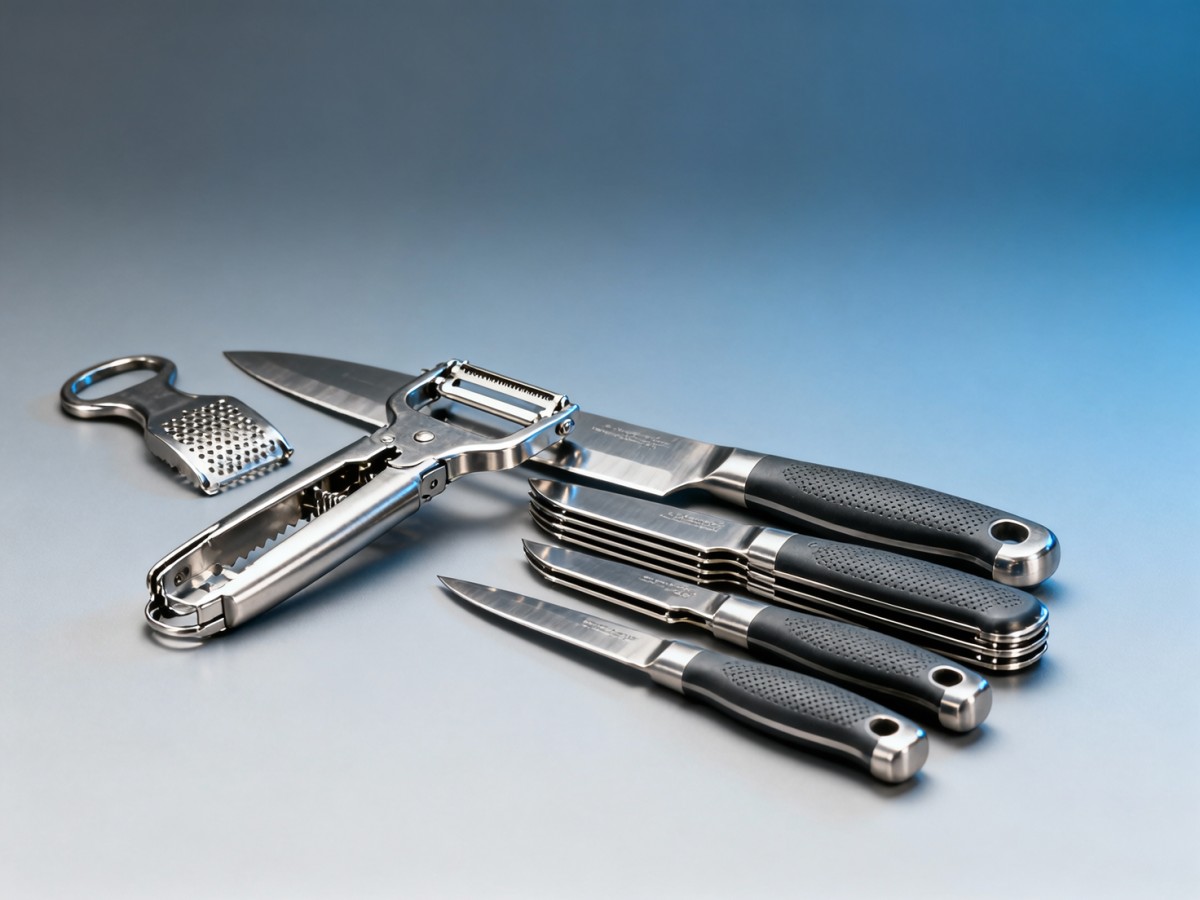
ROI peaks in four high-density environments demanding simultaneous space optimization, food safety rigor, and labor efficiency:
- Urban micro-kitchens: Units under 25 m² serving meal kits or ghost kitchens—where tool storage consumes up to 22% of usable area without modular nesting systems.
- Hospital nutrition units: Where EN 16742-compliant antimicrobial surfaces and single-hand operation reduce cross-contamination risk during 12–16 daily patient meal prep cycles.
- Hotel breakfast stations: Compact induction-compatible cookware sets (3–5 pieces) cut setup time by 40% versus traditional modular setups, per 2023 HVS Global Kitchen Efficiency Survey.
- School cafeterias: Stackable, dishwasher-safe prep tools with color-coded handles (per ISO 22000 Annex A.8) accelerate staff training and reduce misplacement by 65% in high-turnover environments.
How to Evaluate Trade-Offs: Functionality vs. Footprint
Not all space-saving designs meet professional demands. The table below compares performance benchmarks across five critical dimensions for tools used in food processing facilities, restaurants, and institutional kitchens:
Procurement teams should require third-party test reports—not marketing claims—for each metric. Tools passing all three “Verified” thresholds typically show 23–31% lower TCO over 3 years due to reduced replacement, labor, and sanitation costs.
Procurement Checklist for Bulk Orders & OEM Sourcing
When evaluating suppliers—especially factories in China, Germany, Italy, or Japan—focus on verifiable production capabilities and compliance alignment:
- Tooling certification: Confirm CNC die sets are calibrated to ±0.05 mm tolerance (not just “precision-machined”)—critical for nesting accuracy in stackable systems.
- Material traceability: Request mill test reports (EN 10204 3.1) for stainless grades (e.g., 1.4301/304, 1.4404/316L) used in food contact zones.
- Batch validation: Verify minimum batch size (e.g., 500–2,000 units) includes functional sampling per ISO 2859-1 Level II AQL 1.0.
- Delivery readiness: Confirm lead time includes 7–15 days for pre-shipment inspection (PSI), not just production—key for EU CE/UKCA or FDA 21 CFR Part 117 compliance.
Suppliers offering factory audit access, digital twin prototyping, and modular customization (e.g., handle length adjustment ±20 mm) demonstrate capability beyond basic OEM assembly.
Why Partner With a Certified Kitchen Tools Manufacturer?
Choosing a partner aligned with global kitchen equipment industry evolution means accessing integrated support—not just products. We support procurement managers, distributors, and enterprise decision-makers with:
- Customization of tool dimensions, grip ergonomics, and material specs to match your facility’s layout (e.g., 30 cm-deep shelving or narrow pass-through hatches).
- Documentation packages including EN 12563-1 compliance statements, RoHS/REACH declarations, and dishwasher durability test logs.
- Sample validation kits with side-by-side comparison against your current tools—including torque, weight distribution, and cleaning residue analysis.
- Delivery coordination for bulk orders: 4–6 week lead time for standard configurations; 8–10 weeks for custom tooling—guaranteed with penalty clauses.
Ready to validate space-saving performance against your specific operational KPIs? Contact us to request: (1) dimensionally optimized tool specifications, (2) factory audit schedule, (3) compliance documentation preview, or (4) sample set with usage analytics report.
Popular Tags
Kitchen Industry Research Team
Dedicated to analyzing emerging trends and technological shifts in the global hospitality and foodservice infrastructure sector.
Industry Insights
Join 15,000+ industry professionals. Get the latest market trends and tech news delivered weekly.
No spam. Unsubscribe anytime.
Hot Articles
 How to Size a Commercial Oven for Peak Production Without Wasting Energy
- How to Evaluate Foodservice Equipment Suppliers for Reliability, Service, and Total Cost
- How to Choose a Cutlery Set for Restaurants: Material, Durability, and Cost
- How to Evaluate Restaurant Supplies Distributors for Reliable Multi-Location Delivery

Contact With us
Contact:
Anne Yin (Ceramics Dinnerware/Glassware)
Lucky Zhai(Flatware)