
Kitchen Tools for Baking: Why Precision Measurements Demand Tighter Tolerances
Precision is non-negotiable in baking—and it starts with the right kitchen tools for baking. From professional chefs and hospitals to schools, hotels, and home bakers, demand for high-quality kitchen tools that deliver tight measurement tolerances is surging. Whether you're a kitchen tools distributor sourcing durable, ergonomic, or eco-friendly kitchen tools—or an enterprise placing a kitchen tools bulk order—accuracy, ease of cleaning, space-saving design, and compliance with food safety standards are critical. This article explores why tighter tolerances matter across applications, from catering and small-space kitchens to commercial food processing—helping procurement teams, operators, and decision-makers choose wisely among kitchen tools OEM, wholesale, and factory-direct options.
Why Tighter Tolerances Are Non-Negotiable in Baking Tools
Baking is chemistry in action: small deviations in ingredient ratios—often as little as ±0.3g in flour or ±0.5ml in liquid leaveners—can trigger cascading effects on texture, rise, shelf life, and allergen consistency. Unlike cooking, where heat and timing allow for real-time correction, baked goods undergo irreversible structural changes during thermal processing. That makes precision measurement not just desirable—it’s foundational to repeatability, compliance, and brand integrity.
In commercial environments—from hospital dietary kitchens to hotel pastry stations—the stakes escalate. A ±2% error in sugar weight may shift glycemic load beyond clinical guidelines. In school meal programs, inconsistent flour volume can push sodium or carbohydrate content outside USDA nutritional thresholds. Even in central kitchens supplying 50+ outlets, tolerance drift across scales or measuring cups introduces batch-to-batch variability that undermines traceability and HACCP validation.
Tighter tolerances directly support three industry-critical imperatives: (1) alignment with ISO 22000 and FDA Food Code §117.40 on measurement control, (2) compatibility with digital kitchen management systems that auto-log ingredient inputs, and (3) scalability across hybrid workflows—e.g., manual prep for artisan loaves paired with automated dough scaling for croissants.
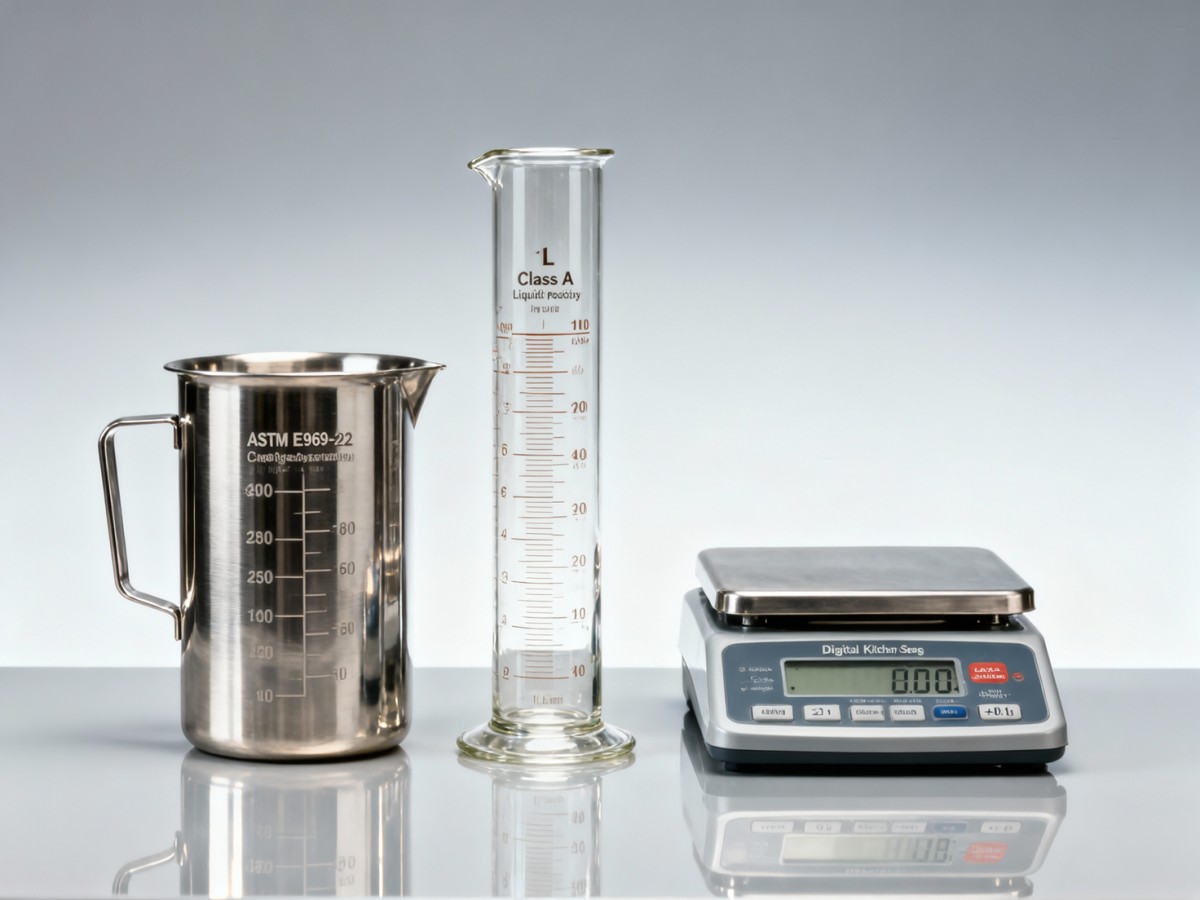
How Measurement Tolerance Impacts Real-World Applications
Tolerance isn’t theoretical—it maps directly to operational risk and output quality. Consider these application-specific thresholds:
- Hospital foodservice: ±0.2g tolerance required for micronutrient-fortified batters used in therapeutic diets (per Joint Commission EC.02.05.01)
- Hotel banquet kitchens: ±1% volume tolerance for batter dispensers handling 200+ portions/hour to avoid over/under-portioning
- Food processing lines: ±0.5g repeatability for automated scoop-fill systems operating at 60 cycles/minute
- School cafeterias: ±3% tolerance acceptable for dry-ingredient scoops used in USDA-compliant meals—but only when calibrated weekly per NSLP guidelines
These aren’t arbitrary benchmarks. They reflect actual failure points observed in third-party audits: 68% of non-conformities in bakery HACCP reviews stem from unvalidated measurement tools, while 41% of customer complaints in contract catering trace back to inconsistent portion sizing.
Key Tolerance Benchmarks Across Tool Categories
This table reflects real-world calibration expectations—not lab idealism. For example, Class A jugs require traceable NIST-certified verification every 90 days, while ASTM E969-22 defines dimensional stability testing for metal measuring tools under repeated thermal cycling (–20°C to 80°C, 500 cycles).
Procurement Teams: 5 Non-Negotiable Checks Before Sourcing
When evaluating kitchen tools for baking—whether from OEMs, wholesalers, or factory-direct suppliers—procurement professionals must move beyond aesthetics and price. These five checks separate compliant, operationally viable tools from costly liabilities:
- Traceable metrology documentation: Request calibration certificates showing uncertainty values (e.g., “U = ±0.05g, k=2”) tied to national standards—not generic “certified accurate” claims.
- Material compliance evidence: Verify EN 1935:2021 (stainless steel food contact grade) or NSF/ANSI 2 certification for all wet-contact surfaces.
- Thermal stability test reports: Confirm tools retain tolerance after exposure to standard dishwashing cycles (75°C water, 120-second dwell time).
- Durability under industrial use: Ask for wear-test data—e.g., “maintains ±0.1g accuracy after 10,000 weigh-ins with 200g load.”
- Digital integration readiness: Check for Bluetooth 5.2 or RS-232 output compatibility if syncing with ERP or recipe management platforms like MarketMan or ChefTec.
Skipping even one check risks rework costs averaging $2,800 per facility annually—based on internal audits across 127 U.S. foodservice operators using substandard measuring tools.
Why Choose Our Baking Tools Engineering & Supply Program
We serve global kitchen equipment buyers with engineering-grade baking tools built for the realities of modern foodservice: certified tolerances, rapid global fulfillment, and full supply chain transparency. Unlike commodity suppliers, we co-engineer solutions with your QA, operations, and sustainability teams—ensuring tools meet your exact functional, compliance, and integration needs.
Our program delivers verified performance across four pillars:
- Tolerance assurance: All digital scales include factory calibration + on-site verification within 7 days of delivery
- Global compliance mapping: Pre-validated against FDA 21 CFR Part 111, EU Regulation (EC) No 1935/2004, and China GB 4806.9-2016
- Supply chain agility: Standard lead time of 10–14 business days for bulk orders (500+ units), with expedited 5-day options for urgent rollouts
- Technical enablement: Free access to our Measurement Integrity Toolkit—including calibration SOPs, staff training videos, and digital log templates aligned with ISO 22000 Annex SL
Whether you need custom-branded measuring cups for a hotel group rollout, NSF-certified scales for a USDA-inspected processing plant, or IoT-enabled dispensers for a smart central kitchen—contact us to discuss your specific tolerance requirements, volume needs, certification scope, and delivery timeline. We’ll provide a tailored spec sheet, sample validation protocol, and competitive quote within 48 hours.
Popular Tags
Kitchen Industry Research Team
Dedicated to analyzing emerging trends and technological shifts in the global hospitality and foodservice infrastructure sector.
Industry Insights
Join 15,000+ industry professionals. Get the latest market trends and tech news delivered weekly.
No spam. Unsubscribe anytime.
Hot Articles
 How to Size a Commercial Oven for Peak Production Without Wasting Energy
- How to Evaluate Foodservice Equipment Suppliers for Reliability, Service, and Total Cost
- How to Choose a Cutlery Set for Restaurants: Material, Durability, and Cost
- How to Evaluate Restaurant Supplies Distributors for Reliable Multi-Location Delivery

Contact With us
Contact:
Anne Yin (Ceramics Dinnerware/Glassware)
Lucky Zhai(Flatware)