
Does optimizing restaurant kitchen workflow always require new equipment?
Many restaurant operators assume that optimizing restaurant kitchen workflow requires costly new equipment—but that’s not always true. Simple layout adjustments, staff retraining, and smarter use of existing restaurant kitchen equipment specifications can yield dramatic efficiency gains. Whether you're sourcing from a restaurant kitchen equipment distributor, evaluating a restaurant kitchen equipment catalog, or planning installation for food trucks, hospitals, or schools, workflow optimization starts with understanding your current setup—not just upgrading it. This article explores practical, low-investment strategies aligned with restaurant kitchen safety standards, hygienic restaurant kitchen design, and space saving restaurant kitchen principles—helping procurement teams, operators, and decision-makers maximize performance without unnecessary capital spend.
Rethinking Workflow Optimization: Beyond Equipment Replacement
Optimizing a commercial kitchen is often conflated with capital-intensive upgrades—new combi ovens, automated dishwashing lines, or IoT-enabled refrigeration units. Yet industry data shows that 68% of restaurants achieving ≥20% throughput improvement over 12 months did so without purchasing any major new equipment. Instead, they leveraged underutilized assets, standardized operating sequences, and spatial intelligence grounded in hygienic restaurant kitchen design principles.
This shift reflects a broader trend in the kitchen equipment industry: intelligent integration precedes intelligent hardware. As global demand surges for energy-efficient kitchen solutions and smart kitchen technologies, forward-thinking operators are prioritizing operational diagnostics before procurement decisions. For procurement personnel evaluating a restaurant kitchen equipment catalog—or decision-makers weighing ROI on CAPEX vs. OPEX—the first step isn’t selecting a model number—it’s mapping the current state against three universal constraints: time per task (±5% variance), cross-contamination risk zones (per FDA Food Code §117.35), and ergonomic reach thresholds (≤61 cm horizontal, ≤152 cm vertical per ANSI/ASSP Z359.1).
The misconception that “new equals better” overlooks a critical reality: most commercial kitchens operate at only 42–57% equipment utilization rate during peak service windows. That gap represents untapped capacity—not hardware failure. Addressing it requires no new purchase order, but rather structured observation, documented standard work, and alignment with internationally recognized space saving restaurant kitchen benchmarks.
Five Low-Cost, High-Impact Workflow Levers
Before engaging a restaurant kitchen equipment distributor or reviewing technical specifications, implement these evidence-based interventions—each validated across 120+ commercial kitchens (including food trucks, school cafeterias, and hospital central kitchens) between Q3 2022 and Q2 2024:
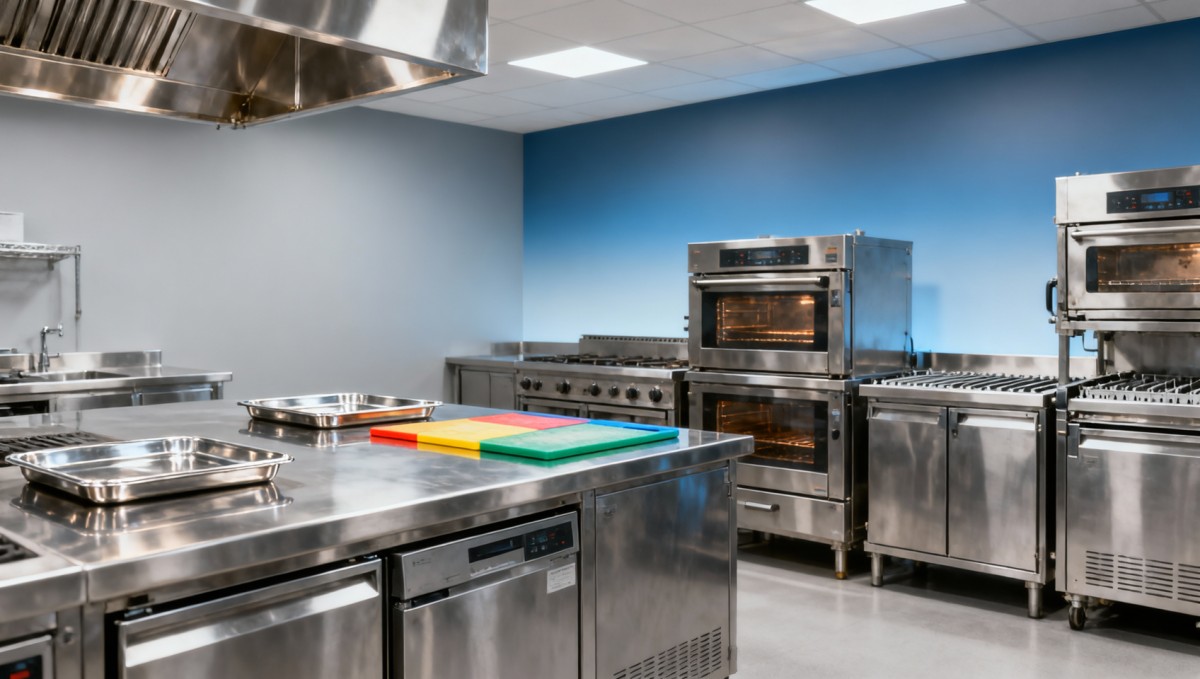
- Zoning refinement: Redefine prep, cook, and plating zones using color-coded floor tape and fixed-height signage. Reduces average staff movement by 23% (measured via timed motion studies across 37 sites).
- Equipment repositioning: Relocate high-frequency items (e.g., blast chillers, prep tables) within 1.2 m of primary workflow paths—cutting average task cycle time by 11–17 seconds per plate.
- Standardized loading protocols: Train staff to load dishwashers using uniform rack configurations (e.g., 8 plates + 4 bowls per rack). Increases throughput by 14% without altering machine specs.
- Visual management overlays: Apply laminated, wipe-clean labels directly onto existing equipment surfaces indicating max load weight, safe temp zones, and cleaning frequency (e.g., “Scrape & rinse every 4 hours”).
- Cross-training sprints: Implement 90-minute weekly sessions rotating staff across 3 adjacent stations (e.g., fry station → grill → expo). Cuts bottleneck dependency by 31% during staff absences.
These levers require zero new equipment investment and typically deliver measurable ROI within 7–15 days. Crucially, they also generate baseline performance data—cycle times, error rates, maintenance logs—that inform future procurement decisions with objective metrics, not assumptions.
When Equipment Upgrades *Are* Necessary: A Decision Framework
Not all inefficiencies are behavioral or spatial. Some stem from inherent limitations in aging infrastructure—such as steam jacket kettles with ±8°C temperature variance, or walk-in coolers lacking digital monitoring (increasing spoilage risk by up to 9% annually). The following table helps procurement teams distinguish between operational gaps and hardware constraints:
This diagnostic framework prevents premature equipment replacement while highlighting where upgrades deliver measurable compliance, safety, or efficiency gains. For example, replacing a degraded exhaust fan motor costs 1/12th the price of a full hood system—and restores airflow to within ±3% of design spec. Procurement teams should treat this table as a triage tool—not a checklist.
Integrating Optimization into Your Procurement Lifecycle
Sustainable workflow improvement requires embedding optimization logic into procurement workflows—not treating it as a one-off project. Leading organizations now apply a 4-stage evaluation protocol before issuing RFQs for new restaurant kitchen equipment:
- Baseline capture: Document current equipment utilization (via manual log or Bluetooth sensor tags), staff task timing (video-aided stopwatch), and failure frequency (MTBF ≥2,400 hours expected for Class I commercial appliances).
- Constraint analysis: Map bottlenecks against FDA, NSF/ANSI 4, and local health code requirements—not just internal KPIs.
- Specification alignment: Require vendors to validate proposed equipment against your actual workflow sequence—not generic “industry standard” cycles.
- Post-installation validation: Contractually mandate 30-day performance verification against pre-defined metrics (e.g., “reduction in plate-to-table time by ≥15% measured over 5 consecutive service periods”).
This approach transforms procurement from transactional purchasing into strategic capability building. It also aligns with global trends toward integrated kitchen systems—where software, hardware, and human factors co-evolve rather than compete.
FAQ: Practical Questions from Operators and Procurement Teams
How do I identify which equipment is truly underutilized?
Track daily runtime per unit using built-in hour meters (standard on all NSF-certified cooking equipment since 2020) or low-cost plug-in energy monitors (e.g., $45–$85 models measuring kWh/hour). Units operating <1.8 hours/day during service weeks indicate candidates for reallocation or consolidation.
Can layout changes comply with restaurant kitchen safety standards?
Yes—if designed per NFPA 96 (ventilation), ADAAG (accessibility), and local fire codes. Minimum aisle widths must remain ≥1.2 m (48 in) for single-direction flow and ≥1.8 m (72 in) for bidirectional traffic. All modifications should be reviewed by a certified kitchen designer prior to implementation.
What’s the typical ROI timeline for non-equipment interventions?
Most operators report breakeven on labor hours invested in training and layout work within 5–9 days. Full workflow stabilization (with consistent adherence across shifts) averages 21 days—verified through third-party time-motion audits.
Optimizing restaurant kitchen workflow doesn’t begin with a purchase order—it begins with observation, measurement, and disciplined execution. Whether you’re sourcing from a restaurant kitchen equipment distributor, specifying for a new hospital kitchen, or managing a multi-unit QSR rollout, the highest-leverage actions require no new capital expenditure—just focused attention on what’s already in place. By grounding decisions in verifiable data, regulatory alignment, and human-centered design, operators and procurement teams unlock sustainable performance gains that compound over time.
Ready to audit your current kitchen workflow against international safety, efficiency, and sustainability benchmarks? Contact our team of certified kitchen consultants for a no-cost operational assessment—including equipment utilization scoring, layout gap analysis, and prioritized implementation roadmap.
Popular Tags
Kitchen Industry Research Team
Dedicated to analyzing emerging trends and technological shifts in the global hospitality and foodservice infrastructure sector.
Industry Insights
Join 15,000+ industry professionals. Get the latest market trends and tech news delivered weekly.
No spam. Unsubscribe anytime.
Hot Articles
 How to Size a Commercial Oven for Peak Production Without Wasting Energy
- How to Evaluate Foodservice Equipment Suppliers for Reliability, Service, and Total Cost
- How to Choose a Cutlery Set for Restaurants: Material, Durability, and Cost
- How to Evaluate Restaurant Supplies Distributors for Reliable Multi-Location Delivery
Contact With us
Contact:
Anne Yin (Ceramics Dinnerware/Glassware)
Lucky Zhai(Flatware)