
How kitchen tools manufacturers handle low-volume orders
For buyers comparing a kitchen tools manufacturer, low-volume orders often raise questions about flexibility, pricing, and customization. Whether sourcing commercial kitchen tools, durable kitchen tools, or stainless steel kitchen tools for restaurants, catering, baking, or home use, understanding how manufacturers manage small batches helps control restaurant supplies cost and secure reliable supply. This guide explains the key processes, pricing factors, and supplier strategies behind low-volume kitchen tools wholesale orders.
In the kitchen equipment industry, low-volume orders are no longer a niche request. Independent restaurants, regional distributors, e-commerce sellers, hotel groups testing new concepts, and procurement teams replacing selected tools often need 50, 200, or 500 pieces rather than full-container quantities. That shift has pushed manufacturers to redesign sourcing, production planning, packaging, and quality control around smaller but more frequent orders.
For decision-makers, the key question is not simply whether a supplier accepts a small batch. The more important issue is how the kitchen tools manufacturer handles material planning, tooling costs, lead time, inspection, and repeatability without driving up total landed cost. A supplier that manages low-volume production well can help buyers test markets faster, reduce inventory pressure, and maintain product consistency across multiple reorder cycles.
Why low-volume kitchen tools orders matter in today’s market
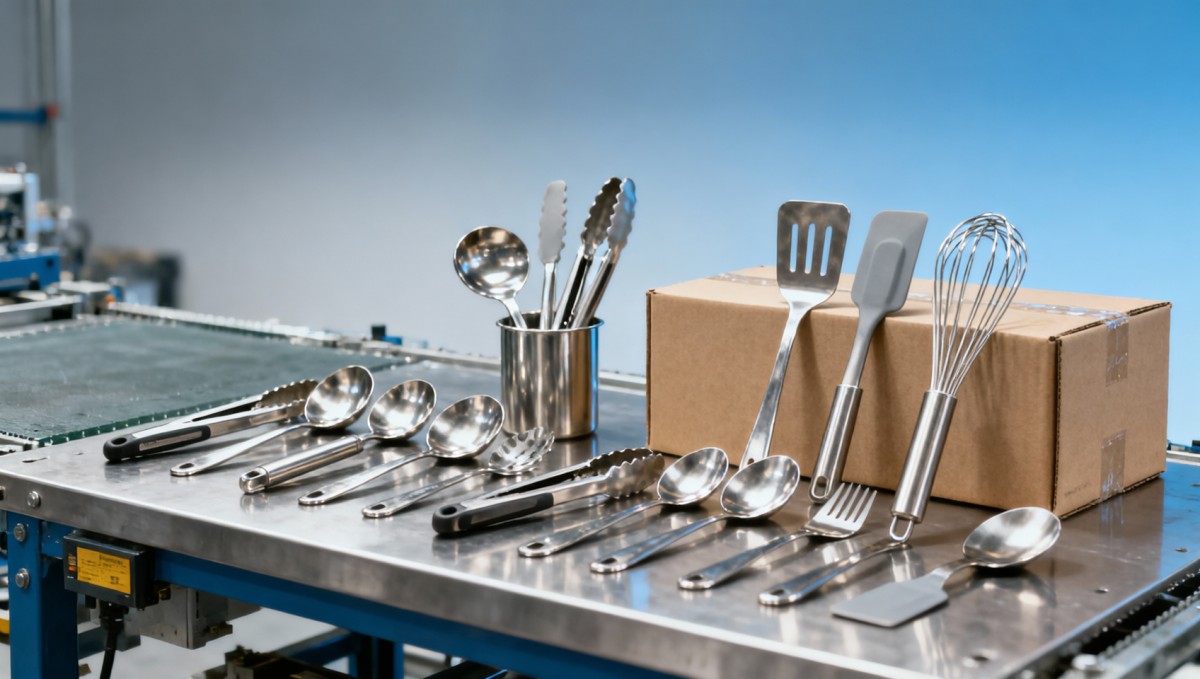
Low-volume demand is growing because procurement behavior has changed. Many buyers now prefer shorter purchasing cycles of 30 to 90 days instead of holding 6 to 12 months of stock. This is especially common for kitchen tools wholesale programs serving restaurant openings, seasonal menu changes, pilot retail launches, and replacement demand for high-use utensils.
In commercial kitchens, usage intensity varies widely. A hotel buffet may need 80 ladles and serving tongs in one phase, while a bakery may only need 120 bench scrapers, whisks, and spatulas for a single site. For these buyers, ordering 2,000 units to meet a factory MOQ can create storage costs, slower cash turnover, and a higher risk of dead stock if specifications change later.
Manufacturers that support small-batch kitchen tools orders often do so by standardizing components. Handles, steel gauges, packaging inserts, and logo methods are grouped into modular options. Instead of building every SKU from scratch, the supplier combines existing materials and semi-finished parts. This lowers setup time and can reduce the MOQ from 1,000 pieces to 100 to 300 pieces, depending on the item category.
The operational value is significant for both users and buyers. Operators gain access to tools matched to workflow, such as heat-resistant turners for grill stations or stainless steel kitchen tools for prep zones requiring easier sanitation. Procurement teams gain more control over assortment strategy, especially when they need to compare 3 to 5 product variants before scaling one final version.
Typical buyer scenarios for small-batch procurement
- New restaurant openings ordering 50 to 300 mixed utensils for back-of-house setup.
- Distributors testing a private label line in 2 or 3 cities before wider rollout.
- Food processing or central kitchen teams replacing only high-wear tools every 60 to 120 days.
- E-commerce brands validating product-market fit with an initial run of 200 to 500 units.
The table below shows why low-volume orders appear across different buyer groups and what each group usually prioritizes when selecting a kitchen tools manufacturer.
A clear pattern emerges: low volume does not mean low importance. In many cases, these orders are tied to high-value decisions such as new market entry, private label validation, or operational replacement planning. That is why experienced manufacturers treat small orders as strategic business, not as exceptions.
How kitchen tools manufacturers organize production for small batches
A capable kitchen tools manufacturer usually handles low-volume orders through process control rather than through one-off manual work. The first method is SKU rationalization. Products with similar steel thickness, handle material, polishing method, or welding process are grouped into one production window. A batch of 300 skimmers and 300 ladles may be run together if they share 70% to 80% of the same process steps.
The second method is semi-finished inventory. Many suppliers keep common components ready, especially for stainless steel kitchen tools such as spoons, tongs, peelers, and serving utensils. By stocking blank parts or unfinished bodies, the factory only needs to complete the final forming, surface finishing, logo application, and packaging after the order is confirmed. This can shorten lead time from 35–45 days to 15–25 days for standard items.
The third method is flexible line scheduling. Instead of dedicating a full line to one large order, smaller factories often assign 1 shift or even a half-day slot to low-volume jobs, especially when using shared fixtures. This works best for mature products with limited engineering changes. It is less efficient for fully custom molds, but highly effective for proven standard items and minor customized kitchen tools.
Common production models used for low-volume orders
Manufacturers generally choose among three operational models depending on the product type, customization depth, and delivery target.
For buyers, this distinction matters because the quotation structure changes by model. A 200-piece order from stocked semi-finished parts may be practical, while the same volume for a new die-cast handle may not be economically sound. Asking the supplier which production model they plan to use is often more useful than asking for the MOQ alone.
Key control points inside the factory
- Material matching: steel grade, thickness range, and handle material must fit existing inventory or approved substitutes.
- Tooling availability: dies, fixtures, and jigs should already exist or require only minor adjustment.
- Batch inspection: small orders still need dimensional checks, weld integrity review, and finish consistency control.
- Packing efficiency: mixed carton planning is essential when low-volume orders contain 5 to 20 SKUs.
Well-run suppliers also document reorder parameters carefully. If a buyer repeats the same order after 90 days, the factory should be able to match handle color, polish level, carton marks, and logo location with minimal deviation. For restaurant and hospitality procurement, this repeatability often matters more than saving a small amount on the first order.
Pricing factors, MOQ logic, and where small orders become expensive
Low-volume kitchen tools orders usually carry a higher unit price, but the reason is more complex than “small orders cost more.” The price increase often comes from fixed costs being spread across fewer units. These fixed costs include sampling, machine setup, labor changeover, carton design, barcode labeling, inspection time, and export documentation. On a 100-piece order, these costs may represent 15% to 35% of total value. On a 3,000-piece order, the share is much lower.
MOQ is also not one number. For many kitchen tools manufacturers, there may be at least 3 MOQs: production MOQ, logo MOQ, and packaging MOQ. A supplier may accept 200 units for the tool itself, require 500 units for color box printing, and suggest 1,000 units to optimize raw material purchasing. Buyers who understand this layered MOQ structure can negotiate more effectively by choosing plain packaging, one-color marks, or shared cartons in the first run.
Material selection strongly affects cost at low volume. Stainless steel kitchen tools using 304 grade generally cost more than 201 grade, while silicone, nylon, wood, or composite handles each introduce different sourcing and quality risks. In small quantities, material waste and offcut utilization also matter. A factory that can nest multiple products from the same steel sheet often controls waste better than one producing isolated SKUs.
Typical cost drivers buyers should ask about
- Tooling and fixture adjustment fees for custom shapes or sizes.
- Logo application method, such as laser marking, etching, embossing, or printing.
- Packaging complexity, especially if each SKU needs retail-ready boxes or multilingual inserts.
- Inspection standard, including full check, AQL-based sampling, or customer-defined checkpoints.
- Shipping consolidation, because low-volume orders often move by LCL, air, or courier rather than FCL.
The table below helps procurement teams compare how different customization choices affect MOQ and cost efficiency.
A practical rule for buyers is to separate “must-have” customization from “nice-to-have” customization. If the first order is under 300 pieces, the most economical path is often standard product + custom logo + simplified packaging. Once monthly demand stabilizes for 2 or 3 reorder cycles, deeper customization becomes easier to justify.
Quality control, compliance, and delivery planning for small-batch orders
Low volume should not mean lower quality standards. In fact, smaller orders can carry higher brand risk because they are often used for market testing, premium hospitality environments, or new account acquisition. A kitchen tools manufacturer handling these orders should still define inspection points for dimensions, surface finish, handle attachment, edge smoothness, and packaging accuracy. Even for a 200-piece run, the buyer should know whether the factory uses 100% visual inspection or sample-based inspection.
For food-contact items, material consistency is especially important. Buyers of stainless steel kitchen tools should confirm the agreed steel grade, finish type, and cleaning suitability. In practical sourcing terms, this means checking whether the product is intended for high-moisture prep areas, dishwasher exposure, acidic food contact, or heavy daily restaurant use. A mismatch here can lead to early corrosion complaints, discoloration, or shorter service life.
Delivery planning also deserves closer attention with low-volume orders because transport mode changes the cost equation. A 100 kg shipment may travel by courier or air for urgency, while 0.5 to 2 cubic meters often moves by LCL sea freight. Buyers should request packing dimensions, net and gross weight, and carton counts before approving final production. This helps estimate landed cost, warehouse handling, and last-mile distribution more accurately.
Core checks before approving production
- Confirm drawing or sample approval, including size tolerance, material, finish, and logo position.
- Review pre-production sample photos or physical samples if the order includes custom packaging.
- Verify carton marks, barcode format, and pack count per carton to avoid receiving errors.
- Set acceptance criteria for appearance defects, weld marks, burrs, and count accuracy.
The following table outlines a practical control checklist that procurement teams can use when buying low-volume kitchen tools wholesale orders.
For operations teams, the benefit of this discipline is straightforward: better tool consistency in daily use. For buyers and executives, it reduces rework, claim handling, and emergency replenishment. Small orders only work well when documentation is clear enough to support a second and third order without restarting the entire approval process.
How buyers can choose the right supplier for low-volume kitchen tools wholesale
When evaluating a kitchen tools manufacturer for low-volume orders, buyers should look beyond the headline MOQ. A more reliable comparison includes 4 core dimensions: production flexibility, customization practicality, quality consistency, and communication speed. A supplier that answers technical questions within 24 to 48 hours and provides clear SKU-by-SKU cost breakdowns is usually easier to manage than one offering a low price but vague execution details.
It is also useful to assess whether the manufacturer understands your end-use environment. Commercial kitchen tools for restaurants, catering, and baking require different priorities than household sets. Restaurant buyers usually care more about durability, cleanability, and replacement continuity. Retail buyers may place more emphasis on packaging presentation, unit economics, and visual finish. The best suppliers align product recommendations with these real usage conditions.
Another sign of a strong partner is transparency about what should remain standard in the first order. Experienced factories often advise customers to keep 70% to 80% of the product standard and customize only the parts that affect branding or functionality most. That approach lowers cost risk, speeds production, and creates a cleaner path to scale if the initial run performs well.
A practical supplier evaluation checklist
- Can the supplier support mixed-SKU orders with a total volume of 300 to 1,000 pieces?
- Do they offer standard products that can be customized without new molds?
- Can they provide sample confirmation, carton details, and lead-time milestones before deposit payment?
- Do they explain the difference between product MOQ, packaging MOQ, and branding MOQ?
- Can they maintain the same specification across repeat orders placed 60 to 180 days apart?
Common mistakes buyers should avoid
One common mistake is over-customizing the first order. Adding a new shape, custom color handle, printed retail box, and multi-language insert at once may look attractive, but it can push a small project into an uneconomical production model. Another mistake is comparing quotations without matching the specification line by line. Small differences in steel grade, finish level, handle structure, or carton count can distort the unit-price comparison.
A third mistake is ignoring replenishment strategy. If a tool is expected to be reordered every quarter, buyers should confirm whether the manufacturer can reserve tooling, save packing files, or maintain semi-finished inventory. That operational readiness may be worth more than a 3% to 5% unit-price difference on the first shipment.
FAQ for low-volume kitchen tools sourcing
How low can the order quantity be?
For standard kitchen tools, some manufacturers can accept 50 to 200 pieces per SKU if the item uses existing materials and simple packaging. For private label or retail-ready packaging, the workable level is often 200 to 500 pieces. Fully custom products usually need higher volumes because tooling and setup costs must be absorbed over more units.
How long does delivery usually take?
If the supplier has semi-finished inventory, 7 to 20 days is possible for standard items. More typical low-volume production takes 15 to 30 days, while a custom make-to-order project may require 30 to 60 days. Transit time then depends on freight mode and destination market.
What is the best way to lower cost on a small order?
Use existing product designs, limit customization to logo and carton label, combine related SKUs into one shipment, and standardize pack counts. Buyers can also ask whether neutral packaging or shared inserts are available for the first run. These changes often improve cost efficiency without reducing product usability.
Low-volume sourcing works best when buyers and manufacturers treat it as a structured program rather than a special favor. The right kitchen tools manufacturer will explain where flexibility exists, where MOQ limits come from, and how to balance customization, lead time, and landed cost. That makes low-volume orders practical for restaurant supplies, distributor testing, private label launches, and ongoing replacement planning.
If you are evaluating commercial kitchen tools, durable kitchen tools, or stainless steel kitchen tools for a small-batch project, a clear specification sheet and a realistic sourcing plan can save weeks of delay and avoid unnecessary cost. Contact us to discuss your target quantity, packaging needs, and delivery schedule, and get a tailored low-volume sourcing solution for your kitchen tools wholesale program.
Popular Tags
Kitchen Industry Research Team
Dedicated to analyzing emerging trends and technological shifts in the global hospitality and foodservice infrastructure sector.
Industry Insights
Join 15,000+ industry professionals. Get the latest market trends and tech news delivered weekly.
No spam. Unsubscribe anytime.

Contact With us
Contact:
Anne Yin (Ceramics Dinnerware/Glassware)
Lucky Zhai(Flatware)