
What to Check When Choosing a Stainless Steel Preparation Table for Commercial Kitchens
A stainless steel Preparation Table can look like a simple purchase, yet it affects food safety, prep speed, staff comfort, cleaning time, and replacement costs every day. The right choice is not simply the shiniest table or the lowest quotation. Buyers need to confirm the steel grade, worktop thickness, welded construction, usable dimensions, storage layout, load requirements, and how the unit will fit into the actual kitchen workflow.
Many purchasing problems begin when a table is selected from a catalogue image without checking what happens around it: where ingredients arrive, where washed produce drains, where staff plate or portion food, and how the table will be cleaned at the end of a shift. A well-specified unit supports those movements. A poorly specified one becomes a bottleneck, even if the table itself appears durable.
A practical rule is this: choose the Preparation Table from the work process outward, then verify the material and construction details. Starting with price alone often leads to compromises that are costly to correct after installation.
Start With the Job the Preparation Table Must Do
“Preparation table” covers several different working surfaces. A table for vegetable trimming has different requirements from one used for dough handling, seafood preparation, portioning cooked food, or holding small appliances. Before comparing suppliers, define the table's primary task and the surrounding equipment.
For example, a compact restaurant prep station may need an undershelf for containers and dry ingredients. A central kitchen may need a longer, reinforced stainless steel worktable that can handle heavy mixing bowls, food processors, and repeated loading. A bakery may value a smooth, broad surface with minimal seams. A meat or seafood area may need a raised edge, drainage provision, or a layout that limits liquid transfer to adjacent work zones.
Do not assume one standard design can serve every station. A table that works well beside a cold storage unit may be unsuitable near a warewashing area, where splashing water and traffic create different hygiene and durability demands.
- What food is prepared here, and is it raw, cooked, allergen-sensitive, or high-moisture?
- How many people will use the surface at the same time?
- Will staff cut directly on boards placed on the table, or will equipment sit on it?
- Does the location need lower storage, an overhead shelf, drawers, a sink, or a backsplash?
- Can the table be moved through existing doors, lifts, corridors, and kitchen access points?
These questions may sound basic, but they prevent a common mistake: buying a table sized only for the available floor space instead of the work that needs to happen on it.
Check the Stainless Steel Grade, Not Just the Word “Stainless”
Stainless steel is not a single material specification. Two tables can look nearly identical on delivery day and perform very differently after regular exposure to salt, acidic foods, cleaning chemicals, moisture, and impact.
For many commercial kitchen applications, grade 304 stainless steel is a sensible benchmark because of its corrosion resistance and general suitability for foodservice environments. Grade 201 may be offered at a lower cost and can be acceptable in lower-demand, dry indoor applications, but it requires a closer review where humidity, salt, or frequent chemical cleaning are involved. In demanding wet, coastal, or high-salinity settings, buyers should discuss whether a more corrosion-resistant specification is appropriate for the local environment and the intended use.
The purchase order should state the actual steel grade for the top, legs, shelves, and any backsplash rather than relying on a generic description such as “high-quality stainless steel.” Mixed-material construction is common: a supplier may use one grade on the visible top and a different material elsewhere. That is not automatically wrong, but it must be disclosed so the buyer can assess the operational risk.
Surface finish also matters. A brushed or satin finish can make normal use marks less obvious than a mirror finish, while still allowing routine cleaning. The key point is not appearance; it is whether the finish is even, smooth, free from sharp burrs, and practical to maintain.
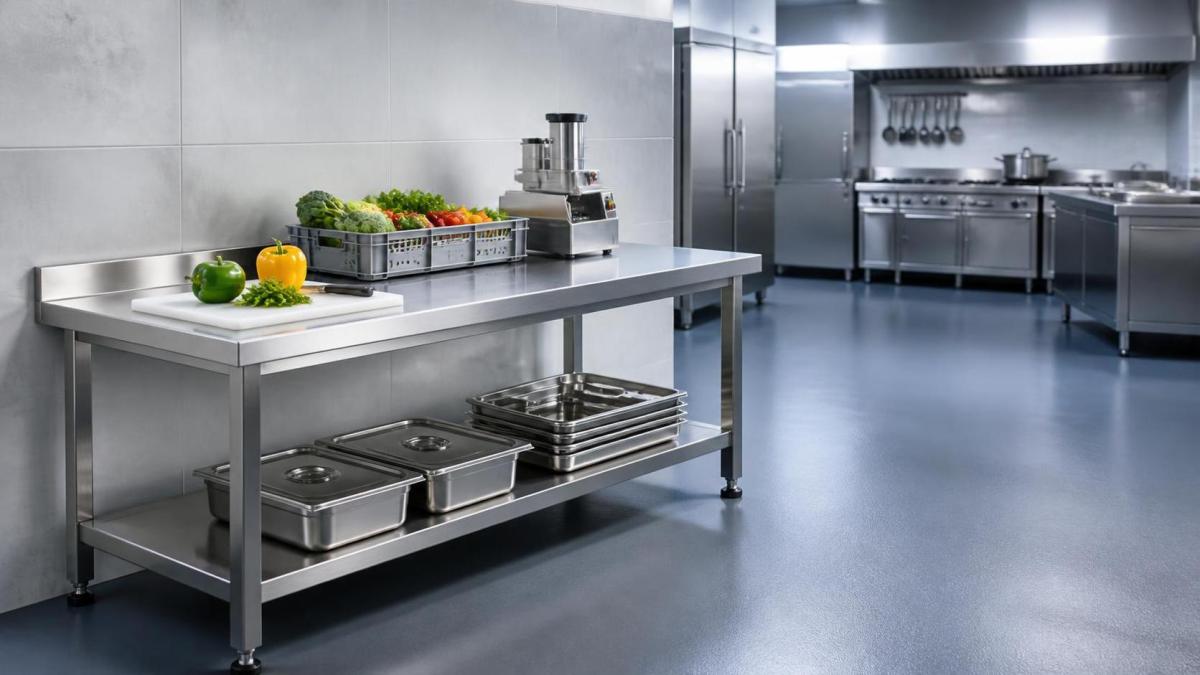
Construction Quality Is Where Long-Term Value Shows Up
Thin stainless steel can dent, flex, and transmit vibration from mixers, slicers, or other countertop equipment. That affects more than appearance. A flexing worktop can make portioning and cutting less stable, allow water to sit in low spots, and loosen joints over time.
Ask the supplier for the worktop thickness or gauge, the internal reinforcement method, and the table's stated load capacity. There is no universal “best” thickness because the required strength depends on span, table dimensions, and expected use. What matters is that the construction matches the load. A long table with no proper support beneath the centre may sag even when the metal sheet initially feels solid.
Look closely at the legs, cross-bracing, shelf supports, and feet. Welded joints are generally preferred at critical structural points because they reduce movement and simplify cleaning compared with poorly fitted or loosely assembled connections. Welds should be continuous where hygiene requires it, smooth enough to avoid food traps, and free from visible cracks or rough edges.
Adjustable feet are more important than they first appear. Commercial kitchen floors are rarely perfectly level, and an unstable table is both a safety issue and an irritation for staff. Where frequent washdown is expected, raised legs also make it easier to clean beneath the unit. In some layouts, casters may be useful for cleaning access or flexible production lines, but only if they have appropriate locks and the table is not intended to support unstable heavy equipment.
Size the Work Surface Around Workflow, Not Catalogue Categories
Length and width are only part of the dimensional decision. The usable work area can be reduced by a backsplash, shelf posts, sink bowls, equipment, ingredient pans, or wall clearance. Confirm the clear flat area staff will actually have for preparation.
Height deserves the same attention. A table that is too low encourages bending and fatigue; one that is too high makes repetitive cutting and lifting uncomfortable. The best working height depends on the task and the people using it. Fine knife work, heavy mixing, and packing do not always suit exactly the same height. If the operation has a standardized workstation height, align the new table with it. If not, ask the kitchen team to assess a sample or a comparable existing table before placing a large order.
Space around the table must support movement as well as work. A prep table placed too close to ovens, refrigerators, dishwashing equipment, or another workstation can create collisions during busy periods. It can also make routine cleaning difficult. Procurement should obtain a simple kitchen layout with dimensions, service connections, door swing areas, and staff travel paths before final approval.
For a high-volume line, a single oversized table is not always the best answer. Two smaller tables can sometimes separate raw and ready-to-eat preparation more effectively, improve cleaning access, and allow one station to remain in service while the other is being sanitized. The choice depends on the food safety plan and available space, not on a general preference for larger equipment.
Storage Features Should Reduce Movement, Not Create Clutter
An undershelf is useful when it keeps frequently used containers, utensils, scales, or dry goods close to the workstation. It becomes counterproductive when it is used as an uncontrolled storage area that restricts cleaning or encourages items to be placed directly beneath food preparation.
Open undershelves suit items that need frequent access and can be kept organized. Cabinets or drawers may be better for small tools, packaging materials, or items needing protection from dust and splashes. Drawer slides, handles, hinges, and door edges should be checked for smooth operation and cleanable construction. These are often the first parts to fail on lower-quality units.
A backsplash is valuable when the table sits against a wall and there is a real risk of food debris or liquid reaching the gap. It protects the wall and reduces difficult-to-clean seams. It is less useful when the table is designed as a pass-through or island workstation, where access from both sides is needed. Adding a backsplash by default can reduce flexibility without solving a real hygiene problem.
Cleaning and Food Safety Need a Physical Inspection
Food safety requirements vary by location and operation, so local rules and internal sanitation procedures should be confirmed before purchase. Still, several practical checks apply almost everywhere.
Inspect corners, shelf edges, leg joints, seams, and undersides. These areas collect residue when fabrication is poor. Avoid deep crevices, exposed fasteners in food-contact zones, rough welds, unsealed joints, and sharp corners that are difficult to wipe safely. A surface can be stainless steel and still be hard to sanitize if its construction creates inaccessible gaps.
Also ask how the table should be cleaned. Harsh or unsuitable chemicals can damage finishes or leave corrosion-like staining on stainless surfaces. In daily operations, staff should remove food debris promptly, use cleaning products compatible with the material, rinse where required, and dry the surface rather than allowing moisture and residues to remain. Procurement should make sure the recommended cleaning method matches the site's actual cleaning routine, not an idealized one.
One frequent misconception is that stainless steel is maintenance-free. It is durable and hygienic when selected and maintained properly, but it can still stain, pit, or show surface corrosion under aggressive conditions. Steel grade, exposure, cleaning chemicals, and maintenance practices need to be evaluated together.
Compare Quotations on a Like-for-Like Basis
A low quotation may exclude the details that determine usability: undershelf configuration, reinforced top, adjustable feet, casters, backsplash, packaging, delivery, installation, or custom dimensions. It may also leave the steel grade and thickness unspecified. Comparing only the final price makes a cheaper offer look better than it really is.
Request a specification sheet and use the same comparison points for every supplier:
- Overall dimensions and usable worktop dimensions
- Stainless steel grade for each major component
- Top thickness and reinforcement details
- Load capacity and intended equipment use
- Welded, bolted, or knock-down construction
- Storage, backsplash, sink, drawer, or caster options
- Cleaning guidance, warranty terms, spare-part availability, and lead time
For large orders or custom fabrication, a sample, detailed drawing, or pre-production approval can be more valuable than a small unit-price reduction. This is particularly true for hotels, institutional kitchens, food processing facilities, and multi-site restaurant groups, where repeating a specification error across several locations is expensive.
The broader kitchen equipment market now includes more automated preparation equipment, digital kitchen controls, and energy-conscious systems. Those developments can change the demands placed on a stainless steel work surface. A Preparation Table may need to support a compact processing device, create a staging area between automated and manual steps, or fit within a tighter integrated line. The table remains a basic item, but it should be specified as part of the operating system rather than treated as an afterthought.
When Custom Fabrication Makes Sense
Standard tables are usually the right answer when the task is straightforward, space is regular, and replacement speed matters. They are easier to compare, often faster to source, and simpler to replace later.
Custom fabrication becomes reasonable when a standard unit leaves unusable gaps, blocks required access, needs a specific sink or equipment cut-out, or must align with an existing production line. It can also be justified where a central kitchen needs a defined sequence of washing, trimming, portioning, and transfer. The buyer should not request customization merely to make the table look distinctive. Every custom detail should solve a measurable workflow, hygiene, access, or capacity problem.
Before approving a custom stainless steel Preparation Table, review a dimensioned drawing with operations staff, cleaning staff, and the installer. Confirm clearances for plumbing, wall fixing, electrical equipment, doors, and maintenance access. A drawing may be technically correct while still failing to account for the space needed to remove a bin, open a refrigerator door, or move a trolley through the kitchen.
Final Purchase Checks Before Release
Before issuing the order, confirm the specification in writing, inspect samples where practical, and verify that the delivery route can handle the assembled unit. On arrival, check dimensions, steel grade documentation where supplied, surface condition, weld quality, level stability, accessories, and any custom features before the table enters service.
The best Preparation Table is not necessarily the most expensive model or the most heavily featured one. It is the unit that fits the food process, withstands its real load and cleaning conditions, supports staff movement, and remains easy to maintain over its service life. That is the standard a commercial kitchen purchase should be measured against.
Frequently Asked Questions
Is grade 304 stainless steel always necessary for a Preparation Table?
Not always. It is commonly preferred for demanding foodservice use because of its corrosion resistance, especially where moisture, salt, acidic ingredients, or frequent cleaning are present. A lower-grade option may suit a dry, light-duty area, but the intended environment should drive the decision.
Should a prep table have wheels?
Choose casters when regular movement improves cleaning access or supports a flexible production layout. For a fixed heavy-duty station or a table carrying equipment that must remain stable, adjustable feet are usually the better choice.
How can buyers tell whether a worktop is strong enough?
Ask for the top thickness, reinforcement details, supported span, and stated load capacity. Then compare those details with the actual weight of equipment, containers, and ingredients expected during peak operation.
Are undershelves always useful?
No. They help when they keep frequently used items organized and accessible. In wet or high-cleaning areas, an undershelf can become a hygiene and access problem if it is overcrowded or difficult to reach beneath.
What should be checked when the table is delivered?
Verify dimensions, stability, worktop condition, welds, feet or casters, accessories, and custom features against the approved order. It is far easier to resolve discrepancies before the table is installed and used.
Popular Tags
Kitchen Industry Research Team
Dedicated to analyzing emerging trends and technological shifts in the global hospitality and foodservice infrastructure sector.
Industry Insights
Join 15,000+ industry professionals. Get the latest market trends and tech news delivered weekly.
No spam. Unsubscribe anytime.

Contact With us
Contact:
Anne Yin (Ceramics Dinnerware/Glassware)
Lucky Zhai(Flatware)