
How to Select a Glass Washer for Laboratory, Pharmaceutical, and Food Production Use
Selecting a Glass Washer for controlled or hygiene-sensitive operations starts with one practical question: what must the wash process reliably remove, and what must the cleaned item be ready for next? The answer differs sharply between a laboratory preparing glassware for analysis, a pharmaceutical site supporting validated production, and a food facility washing bottles, jars, or process accessories.
A machine that produces visually clean glass is not automatically suitable for a process where residues can affect test results, product safety, or audit records. Procurement should therefore evaluate the complete washing system: the load, water quality, detergent chemistry, wash action, drying method, documentation, installation conditions, and daily operating discipline. Capacity and purchase price matter, but they should not lead the decision.
Begin with the post-wash requirement
The most costly selection mistake is specifying a washer according to the items being loaded rather than the condition required after unloading. “Glassware” can mean beakers, volumetric flasks, vials, laboratory bottles, reusable food containers, mixing accessories, or large processing vessels. These items have different shapes, soils, and acceptance criteria.
Define the intended next step before comparing models. Will the glass be used for routine non-critical preparation, analytical testing, sterile or controlled manufacturing work, or direct food contact? Is the concern visible residue, microbial control, detergent carryover, mineral spotting, or all of these? A procurement specification built around these questions is more useful than a generic request for a high-temperature washer.
There is overlap among these applications, but there is no universal “best” glass washing machine. A food production line may need rugged, fast batch processing, while a laboratory may accept a longer cycle in exchange for controlled internal washing of narrow-necked vessels. Pharmaceutical purchasing often needs both performance evidence and process traceability.
Match wash action to the load, not just chamber size
Chamber volume can be misleading. A large chamber does not guarantee useful capacity if the machine cannot wash the internal surfaces of the actual vessels. Tall bottles, pipettes, narrow-neck flasks, and tubing-connected glassware often need injection washing through dedicated nozzles or manifolds. Open beakers and trays may clean effectively on standard racks, but they still require stable placement and unobstructed spray paths.
Ask suppliers to show the proposed rack configuration loaded with representative items, including the smallest and most awkward pieces. The review should cover three points: whether each item receives wash water where it is needed, whether it drains completely, and whether loading can be repeated correctly by different operators. A rack that looks efficient on paper can create inconsistent results if staff must arrange each load in a highly specific way.
Consider future load variation as well. A modular rack system can be worthwhile where glassware formats change frequently, but it adds value only when the site has a clear method for choosing and storing the right configuration. For a stable production load, a dedicated basket or custom insert can be faster and less prone to operator error.
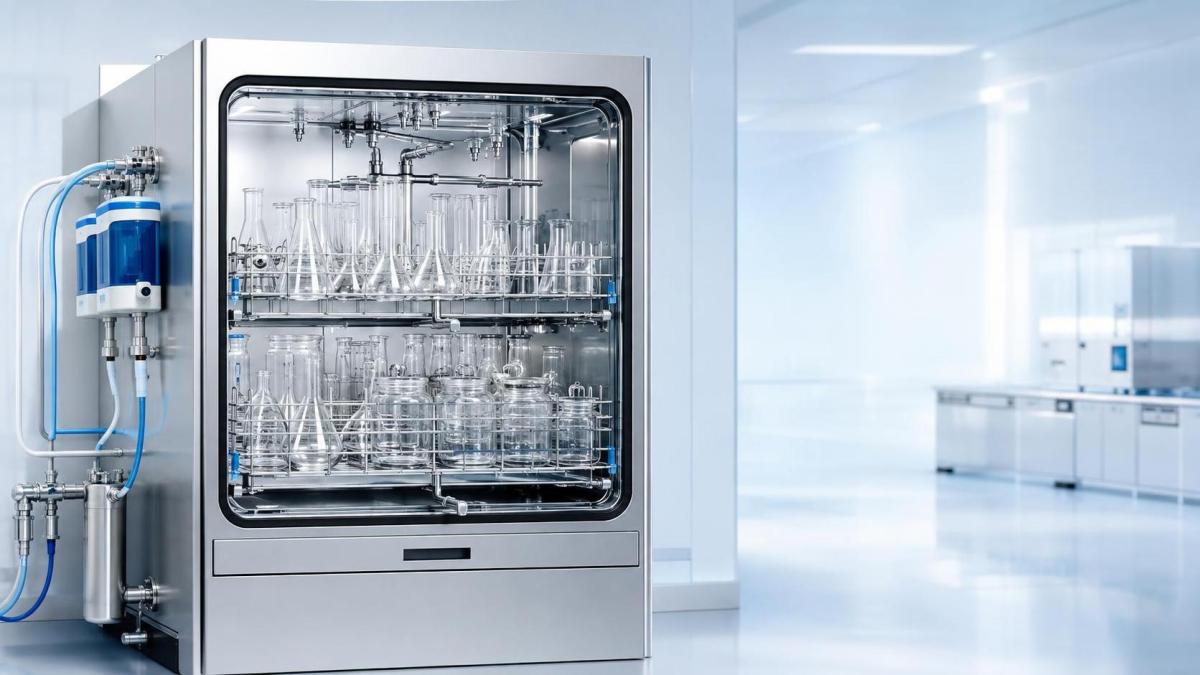
Water quality and drying often determine the final result
Wash mechanics remove soil, but the final rinse determines much of what remains on the glass. Minerals in untreated water can leave spots or deposits. Detergent residues may matter where glassware is used for sensitive analysis or downstream processing. For this reason, the water source should be specified together with the washer rather than treated as a facilities detail to resolve after delivery.
Some applications can operate with an appropriate filtered supply. Others may require treated water for the final rinse to reduce mineral residue or support a controlled cleaning process. The right choice depends on the item’s end use, local water characteristics, and the residues being controlled. It also affects operating cost because treatment equipment, filters, regeneration materials, and monitoring all need ongoing attention.
Drying deserves the same scrutiny. If glassware must be returned to service quickly, assess whether the dryer can handle the expected load geometry, especially bottles or vessels with restricted openings. Poor drainage and insufficient airflow can leave moisture in otherwise clean items, slowing production or encouraging rework. In some operations, air drying in a controlled area is acceptable; in others, integrated filtered-air drying supports a more predictable turnaround.
Cleaning chemistry is part of the equipment decision
A Glass Washer should be selected with its detergent and neutralization approach in mind. Food soils, proteins, oils, sugars, culture media, pharmaceutical residues, and laboratory chemicals do not respond equally to one formulation. A machine may have excellent circulation but still underperform if the chemistry is not compatible with the soil or the glassware material.
Procurement should identify the routine soils, occasional difficult residues, and any substances that require a separate pre-treatment process. Some residues should not enter a standard wash system at all because of safety, chemical incompatibility, or disposal requirements. This decision belongs in the operating workflow, not in an assumption that a stronger wash program will solve every problem.
Automatic dosing is usually preferable where repeatability matters or where manual chemical handling increases risk. It can improve consistency, but it also creates requirements for compatible containers, dosing verification, spill management, and service access. Manual dosing can be workable for low-volume, simple applications, provided operators can follow a clear and repeatable procedure.
Pharmaceutical use requires a stronger focus on control and evidence
For pharmaceutical environments, cleaning performance alone is rarely sufficient. The process may need to be defined, repeatable, reviewable, and aligned with the site’s quality procedures. The purchasing team should involve quality, engineering, and end users early enough to establish what records are required from each cycle and what documentation the supplier can provide for the equipment.
Useful capabilities may include programmable cycle parameters, user access controls, alarms for process deviations, and electronic or printed cycle records. The required level of control depends on the role of the washed glassware. A washer serving non-critical support tasks may not need the same specification as equipment supporting a controlled manufacturing step.
Do not assume that a feature-rich control panel makes a system easier to validate or operate. More programs and options can create more opportunities for incorrect selection. The better fit is usually a machine whose approved cycles are clear, protected as needed, and appropriate for the actual load. Review the supplier’s installation, commissioning, calibration, maintenance, and documentation scope before issuing the purchase order.
Food production priorities: hygiene, uptime, and practical throughput
In food and beverage operations, a washer must work within the pace of production. The relevant capacity is not simply items per cycle. It is the number of usable items returned per shift after loading, washing, drying, unloading, inspection, and any rewash. A faster nominal cycle can lose its advantage if racks are difficult to load or if containers regularly retain water.
For jars, bottles, dispensers, and reusable processing components, inspect spray coverage around threads, shoulders, bases, and internal cavities. Food residues can dry onto these surfaces and become harder to remove. A pre-rinse or pre-soak stage may be more effective than specifying an oversized machine to compensate for poor loading or delayed washing.
Construction and cleanability should also be reviewed in real operating terms. Smooth accessible surfaces, readily cleanable filters, clear fault indications, and convenient access to pumps and dosing connections reduce the burden on maintenance teams. A unit that is difficult to service can become a production constraint even when its wash result is acceptable.
Calculate ownership cost from the proposed operating pattern
Energy and water efficiency should be evaluated against the site’s actual cycle schedule, not a headline claim. Compare the expected programs, water supply requirements, heating method, drying demand, detergent use, consumable filters, labor time, maintenance intervals, and likely spare parts. A lower-priced machine may become the more expensive option when it needs extra cycles, uses a less suitable rack system, or consumes more treated water than the process can support.
Installation feasibility can change the decision just as quickly. Confirm electrical capacity, drainage, ventilation or heat release, water pressure, floor loading, access dimensions, and chemical storage before final selection. Also check whether the machine can be delivered into its intended room and opened for future service. These details are easy to postpone and expensive to correct after purchase.
A practical procurement review before committing
Use representative loads and normal operating conditions when assessing a shortlisted washer. Avoid demonstrations using only clean, easy-to-wash glassware. The evaluation should include the most challenging routinely used items, the relevant soil conditions, the proposed detergent, and the actual available water supply.
- Document the glassware types, dimensions, quantities, and contamination risks.
- Define what “clean and ready to use” means for each application.
- Verify rack layouts, internal washing capability, drainage, and safe loading.
- Assess water treatment, rinse quality, drying needs, and utility connections together.
- Review required records, control features, service coverage, and operator training.
- Compare operating cost using the cycles the site will genuinely run.
The most suitable system is the one that consistently delivers the required result with a workflow operators can follow and maintenance teams can sustain. When specifications are built around real loads, residue risks, and process requirements, procurement can avoid paying for unused complexity while reducing the chance of inadequate cleaning, rework, or disruption later.
Popular Tags
Kitchen Industry Research Team
Dedicated to analyzing emerging trends and technological shifts in the global hospitality and foodservice infrastructure sector.
Industry Insights
Join 15,000+ industry professionals. Get the latest market trends and tech news delivered weekly.
No spam. Unsubscribe anytime.
Hot Articles
 Choosing Commercial Cooking Appliances for Your Menu and Peak Service Demand
- Choosing Bakery Equipment for a Small Bakery: Capacity, Space, and Budget
- How to Choose Glass Office Decor Vases That Enhance Reception and Meeting Spaces
- How to Choose Ceramic Serving Plates for Restaurants, Catering, and Banquet Service



Contact With us
Contact:
Anne Yin (Ceramics Dinnerware/Glassware)
Lucky Zhai(Flatware)