Choosing bakery equipment for a small bakery means balancing production capacity, limited floor space, and a budget that must cover more than the purchase price.
For procurement teams, an oversized oven or undersized mixer can create bottlenecks, raise operating costs, and restrict future growth. Selection should begin with actual production requirements.
The right selection starts with your product mix, daily output targets, and available utilities. Supplier specifications become useful only when measured against these operating conditions.
This guide explains how to evaluate essential equipment, plan an efficient layout, and compare total ownership costs so purchasing decisions support consistent quality and reliable production.
How Much Bakery Equipment Do You Actually Need?
Start with a production brief rather than an equipment catalog. Document products, batch weights, selling hours, peak demand, staffing, and the time available for preparation.
A bakery selling mostly sourdough loaves needs different capacity from one producing cupcakes, cookies, and laminated pastries. Equipment priorities should reflect that difference from the outset.
Separate daily demand from peak production requirements. Selling 300 items throughout the day does not necessarily require producing all 300 before opening each morning.
However, wholesale deliveries and early breakfast sales can concentrate production into short windows. Calculate what must be ready by each deadline, including cooling and packaging.
Map the process from ingredient storage through mixing, fermentation, shaping, proofing, baking, cooling, and dispatch. The slowest constrained stage determines practical output for the entire system.
Allow capacity for plausible growth and production variability, but tie that allowance to sales forecasts. Excess capacity consumes space and capital before generating additional revenue.
Size the Oven Around Your Busiest Baking Window
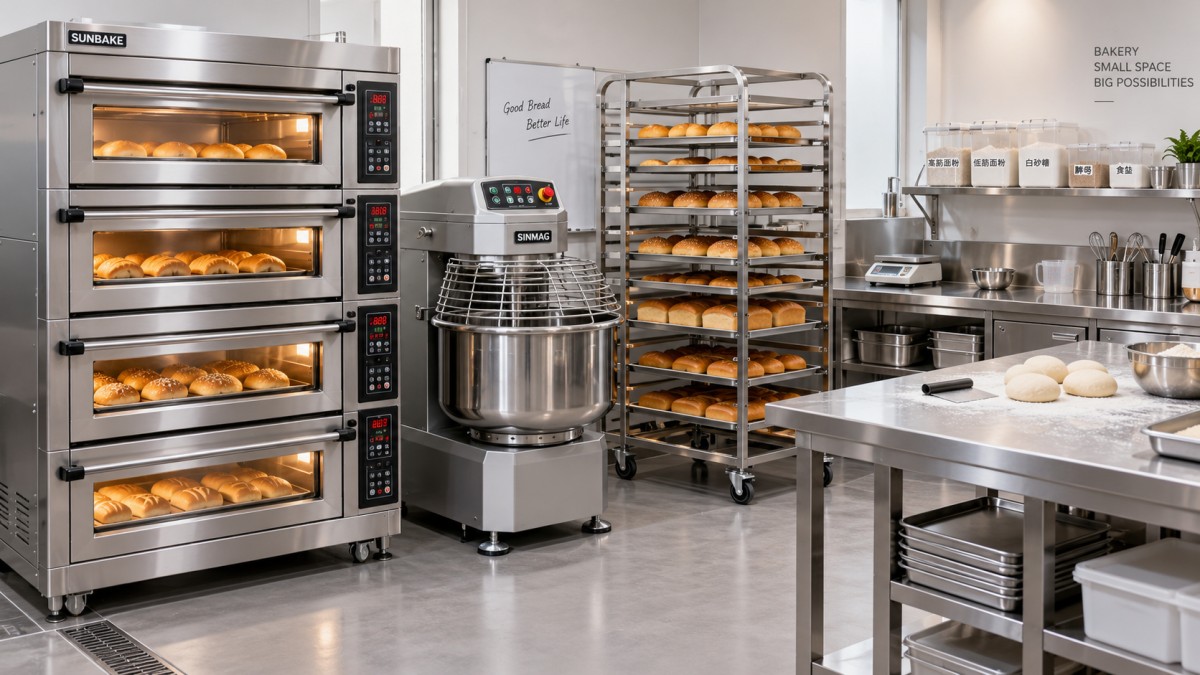
Oven capacity deserves close attention because baking schedules often control morning availability. Compare usable tray positions, product spacing, cycle duration, and recovery between successive loads.
For illustration, an oven holding four trays with 12 rolls each produces 48 rolls per load. Tray dimensions and required spacing must support that arrangement.
If baking takes 20 minutes and loading, unloading, and recovery take another five, the theoretical rate is approximately 115 rolls per hour under those assumptions.
Producing 300 rolls requires seven loads, taking approximately 175 minutes. Scheduling by complete loads gives a more useful answer than dividing demand by theoretical hourly output.
This estimate excludes warmup, interruptions, rejected products, and competing recipes. Validate the schedule through a supplier demonstration using your dough, tray arrangement, and target quality.
Deck ovens often suit hearth breads requiring strong bottom heat and steam. Convection ovens commonly suit tray baking, although airflow can affect delicate products differently.
Do not assume one oven handles every recipe equally well. Evaluate temperature uniformity, steam requirements, recovery, independent controls, and performance when operating below full capacity.
Match the Mixer and Supporting Equipment to Each Batch
Mixer bowl volume is not the same as usable dough capacity. Ask for rated batch weights for your dough type, hydration, and mixing method specifically.
Spiral mixers commonly suit bread dough production, while planetary mixers offer flexibility for batters, creams, and smaller preparation tasks. Selection depends on the dominant workload.
Check minimum batch requirements as carefully as maximum ratings. An oversized mixer may perform poorly with small batches and force unnecessary production or ingredient waste.
If daily dough demand is 60 kilograms and usable capacity is 20 kilograms, plan three batches. Include weighing, loading, mixing, unloading, and cleaning in scheduling.
Proofing space should accommodate dough arriving from mixing and shaping at the required rate. Bread production may also need substantial space for bulk fermentation containers.
Refrigeration requirements depend on ingredient storage, finished fillings, and fermentation schedules. Confirm operating temperatures, usable shelf space, ambient conditions, and recovery after frequent door openings.
Cooling racks, scales, benches, sinks, trays, and storage deserve explicit budget lines. Insufficient cooling space can delay packaging even when mixing and baking capacity appears adequate.
- Prioritize the oven, suitable mixer, required refrigeration, accurate scales, washable work surfaces, trays, racks, and appropriate cleaning facilities.
- Add controlled proofing when product consistency or ambient conditions make it necessary; evaluate retarding separately against the production schedule.
- Consider sheeters, dividers, and depositors when repeatable volume or measured labor savings justify their cost and footprint.
Will the Equipment Fit and Work in Your Premises?
Measure usable working space rather than total floor area. Columns, doors, sinks, storage, service access, and staff movement reduce the area available for productive equipment.
Create a scaled layout showing receiving, storage, preparation, baking, cooling, and packing. Aim for straightforward movement that limits repeated carrying and conflicts between busy stations.
Machine dimensions alone are insufficient. Include door swings, handles, removable bowls, rack movement, operator positions, manufacturer clearances, and access for cleaning and maintenance during layout planning.
Check the delivery route before ordering. Door widths, corridor turns, stairs, loading access, and floor capacity can determine whether installation requires dismantling or specialist handling.
Match electrical voltage, phase, frequency, and available supply capacity to each machine. An electrician should assess simultaneous demand, circuit protection, and any required infrastructure upgrades.
For gas equipment, confirm fuel compatibility and supply requirements. Assess ventilation, combustion air, heat removal, water connections, and drainage with qualified local installers before purchase.
Applicable sanitation, fire, building, and equipment approval requirements vary by location. Confirm acceptance with relevant local authorities before paying deposits, especially when purchasing imported equipment.
Compare Installed Cost and Ownership Cost Before Choosing
The purchase price represents only part of the investment. A cheaper machine can become the more expensive option after installation, energy use, maintenance, and downtime.
Build an installed cost covering equipment, freight, duties where applicable, unloading, positioning, utility connections, ventilation changes, commissioning, accessories, and initial operator training for the proposed installation.
Keep operating cash separate from the equipment budget. Ingredient purchases, payroll, rent, and unexpected repairs still need funding while the bakery establishes predictable sales volumes.
Compare ownership costs over the same period and production assumptions. Include energy, water, scheduled maintenance, consumables, likely repairs, financing costs, and a reasonable residual value.
Energy comparisons require more than checking rated power. Request measured consumption under comparable loads, including preheating and standby, then apply your expected schedule and local tariffs.
For illustration, an oven costing $4,000 more but saving $1,200 annually has a simple payback of approximately 3.3 years, before financing and maintenance differences are considered.
Treat that calculation as a screening tool. Confirm whether the savings hold at your output level and whether the bakery can absorb the higher initial payment.
When Does Used Equipment Make Financial Sense?
Used bakery equipment can preserve capital when its condition, service history, and support are verifiable. Evaluate each machine individually instead of applying one purchasing rule.
Simple stainless steel benches and racks are often easier to assess than electronically controlled ovens or refrigeration systems. Check dimensions, stability, corrosion, and cleaning accessibility.
For a used mixer, inspect guards, interlocks, transmission condition, unusual noise, attachments, and performance under a representative load. Arrange inspection by a competent technician where appropriate.
For ovens and refrigerators, examine seals, controls, heating or cooling performance, maintenance records, and parts availability. Include refurbishment and installation costs before comparing with new alternatives.
Confirm that safety features remain intact and local requirements can be met. A low purchase price loses its advantage if essential repairs delay the opening.
New equipment may justify its premium when dependable production, warranty coverage, and predictable servicing matter most. Refurbished options can work when testing and support are documented.
What Should You Verify Before Approving a Supplier?
Send competing suppliers the same production brief and site information. Comparable requests reduce the risk of evaluating quotations based on different capacities, accessories, or installation assumptions.
Ask for a demonstration with representative products and realistic batch sizes. Record output quality, cycle times, operator effort, cleaning access, and recovery between consecutive loads.
Request references from bakeries with similar products and workloads. Their experience can reveal service responsiveness, common faults, and whether advertised capacity translates into dependable production.
Confirm who handles commissioning, staff training, warranty claims, and repairs. A local service arrangement matters more when one failed machine could interrupt most daily sales.
Agree on acceptance criteria before placing the order. Specify the configuration, included accessories, required documentation, commissioning checks, and how discrepancies will be resolved after delivery.
For imported equipment, clarify delivery terms, responsibility for customs clearance, damage claims, and warranty shipping. Confirm manuals, replacement components, and technical support are practically accessible.
- Obtain written confirmation of model numbers, utility requirements, usable capacity, dimensions, clearances, and all included accessories.
- Verify delivery timing against fitout milestones, allowing time for installation, commissioning, training, and trial production before opening.
- Document warranty exclusions, service contacts, spare parts lead times, and the process for reporting faults.
Choose a Balanced Production System, Then Expand Where Demand Justifies It
The best bakery equipment purchase supports the required product quality and peak output within the actual premises. Every major machine should fit a documented production plan.
Prioritize compatible capacities across mixing, fermentation, proofing, baking, and cooling. Buying a larger oven creates little value when upstream preparation or downstream handling limits usable output.
Approve purchases only after confirming installed cost, utility compatibility, service support, and demonstrated performance. These checks turn an attractive quotation into a defensible procurement decision.
Track actual production times, waste, energy use, and labor after opening. Use that evidence to expand the stage that constrains profitable demand as the bakery grows.