
Kitchen Equipment Maintenance: A Checklist to Reduce Downtime and Extend Service Life
Kitchen Equipment Maintenance: A Checklist to Reduce Downtime and Extend Service Life
A commercial kitchen rarely fails at a convenient time. A combi oven stops heating during a banquet prep window, an ice machine alarms on a Friday evening, or a refrigeration unit begins short-cycling just as a delivery arrives. In most cases, the final breakdown was not sudden. There were earlier signs: a damaged door gasket, a clogged condenser, a loose electrical termination, a neglected water filter, or an alarm that was reset without being investigated.
Effective kitchen equipment maintenance is less about performing the same task on every appliance and more about understanding what each machine depends on. Cooking equipment depends on clean combustion or stable electrical supply. Refrigeration depends on airflow, clean heat-transfer surfaces, and correctly closing doors. Warewashing equipment depends on water quality, chemical delivery, temperature control, and drainage. Smart equipment adds sensors, communication modules, software settings, and logged fault histories to the maintenance picture.
For after-sales teams, the practical objective is straightforward: identify deterioration before it becomes downtime, then leave a traceable record of what was found, adjusted, replaced, and still requires follow-up. A checklist helps, but only if it is tied to the equipment’s actual operating conditions rather than treated as paperwork.
Start With the Conditions That Cause Wear
The same model can have very different service needs in a hotel kitchen, a quick-service restaurant, a central production facility, or a food processing line. Equipment located near fryers collects airborne grease more quickly. Machines in hard-water areas may scale internally even when their exterior looks clean. Units serving continuous shifts experience different wear from appliances used only for breakfast or scheduled production batches.
Before setting a maintenance frequency, review the environment and operating pattern. Ask how often the equipment runs, whether staff follow daily cleaning procedures, what utilities supply it, and whether prior service records show repeated faults. Replacing the same part twice without checking the underlying cause is a common and expensive habit. A failed fan motor, for example, may be linked to grease buildup, heat exposure, a damaged guard, or an unstable electrical supply—not simply a defective motor.
The equipment manual remains the starting point for approved cleaning methods, inspection intervals, lubricants, replacement parts, and safety procedures. It should not be overridden casually. However, maintenance plans often need to become more frequent where loading, water quality, ambient temperature, or sanitation demands are harsher than the original assumptions.
A Working Maintenance Checklist by Service Interval
The checklist below is designed as a field framework rather than a substitute for manufacturer instructions. It helps separate routine operator care from technician-level inspection. Any work involving gas components, high-voltage circuits, refrigerant systems, pressure systems, or internal safety devices should be completed only by suitably qualified personnel and in line with applicable local requirements.
Intervals should be adjusted with judgment. A lightly used appliance may not need a full technical visit as often as a heavily loaded unit, but “light use” does not remove the need for safety checks. Conversely, a busy fryer line or bakery oven may need filter and airflow checks far more often than a generic calendar schedule suggests.
Cooking Equipment: Focus on Heat, Airflow, and Seals
Ovens, fryers, grills, steamers, ranges, and induction units are often serviced after performance has already become visibly poor. The more useful approach is to look for changes in heat delivery. Longer preheat times, uneven browning, slow recovery after loading, unexpected shutdowns, or repeated ignition attempts are not minor complaints. They are clues that should be recorded and checked against normal operation.
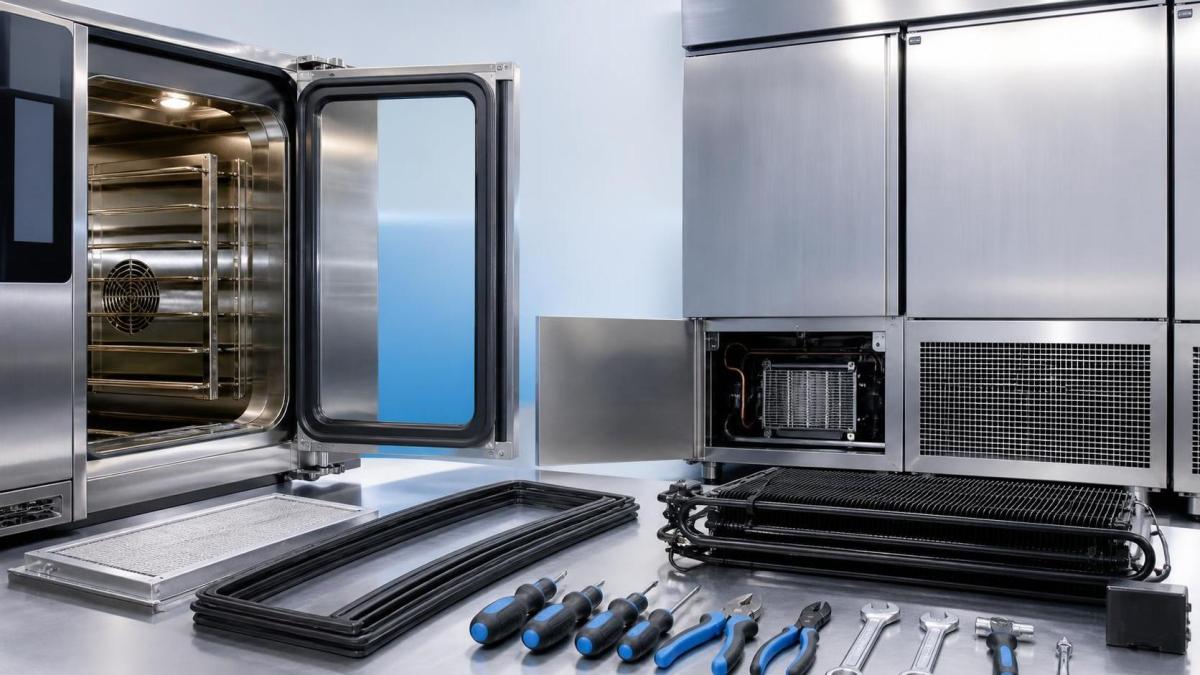
For convection and combi equipment, fans, door gaskets, drain paths, and probe condition deserve close attention. A flattened or torn gasket can waste energy, affect cooking consistency, and allow steam to escape into surrounding components. On steam-generating equipment, scale management matters because mineral deposits can interfere with heating efficiency and water movement. The correct descaling process must match the manufacturer’s instructions; aggressive chemicals or improvised methods can damage seals, sensors, and internal surfaces.
Gas equipment requires particular discipline. Do not treat burner flames, ignition reliability, combustion-related components, or gas connections as routine cleaning items. If operation appears abnormal, isolate the issue according to site procedures and arrange competent inspection. A technician should also pay attention to ventilation conditions. Equipment may appear to have a burner problem when the real issue is poor extraction or a kitchen layout change that affects airflow around the appliance.
Refrigeration Maintenance Is Mostly About Airflow and Habits
Refrigerators, freezers, blast chillers, display cabinets, and ice machines are frequently blamed for “not holding temperature” when several smaller conditions are working against them. Condensers coated in dust or grease cannot reject heat efficiently. Door gaskets with splits or permanent compression allow warm air in. Overloaded shelves can block circulation. Staff may also prop doors open during prep, creating a problem no component replacement will solve.
During kitchen equipment maintenance visits, inspect the condenser area only after safe isolation and with the cleaning method appropriate for the unit. Bent fins, blocked intake paths, failed fans, and unusual compressor cycling should be noted rather than masked by a quick reset. Check drain pans and drain lines for contamination or blockage, especially where condensation management is part of the design.
Ice machines need an even more disciplined approach because water quality, sanitation, and mechanical reliability overlap. Filter replacement should follow the equipment and water-treatment guidance, not a guess based on appearance. Slime, scale, unusual ice formation, or inconsistent harvest cycles justify a deeper investigation. Cleaning an ice machine without checking water flow, drain performance, and service history can leave the real problem untouched.
Warewashing Problems Often Begin Upstream
Dishwashers and glasswashers are judged by the result on the plate or glass, yet that result depends on more than the machine. Wash arms must rotate freely, jets must not be blocked, filters need regular cleaning, and detergent and rinse-aid lines must be correctly positioned and free from leaks or crystallized residue. A poor result can also be associated with incoming water conditions, incorrect chemical settings, loading practices, or insufficient heating performance.
Technicians should avoid changing dosing settings immediately just because users report spotting or poor cleaning. Check the basics first: filter cleanliness, spray-arm condition, chemical pickup, water supply, drain function, and the machine’s operating observations. If temperature-related performance is in question, use the appropriate approved verification method and document what was actually observed. This makes later diagnosis much easier than a report that simply says “machine checked.”
Smart Equipment Needs Both Physical and Digital Care
Connected ovens, automated processing systems, programmable controllers, and digital kitchen management tools have changed the service visit. A clean machine can still be unreliable if a sensor is drifting, a communication connection is intermittent, user settings were changed, or fault logs are ignored. Digital diagnostics can reduce troubleshooting time, but they do not replace a physical inspection. A logged over-temperature event may be caused by a control issue, but it may also point to restricted airflow, a damaged seal, or an operating practice that the software cannot see.
When reviewing smart equipment, record the model, serial number, current software version if accessible, active alarms, alarm history, and any configuration changes made during the visit. Updates should be handled according to the manufacturer’s process, particularly where recipes, temperature controls, connected services, or user permissions are involved. Avoid treating every update as preventive maintenance; if the unit is stable and the update has operational implications, the site should understand what will change before it is applied.
Make Service Records Useful, Not Just Complete
A good maintenance report should help the next technician understand the equipment in minutes. Record the complaint in the user’s words, the operating condition when inspected, visible findings, test results where applicable, parts used, adjustments made, and unresolved risks. Photographs can be useful for damaged seals, corroded terminals, blocked airflow paths, or installation issues, provided site procedures permit them.
It is also worth separating “corrected today” from “monitor” and “requires customer action.” A unit may be technically functional after service but still sit too close to a heat source, lack adequate cleaning access, or be operated with poor loading habits. These conditions should not disappear into a vague recommendation. State the likely consequence in plain language: restricted condenser airflow may lead to rising energy use and reduced cooling performance; a leaking gasket may increase run time and temperature instability.
The best kitchen equipment maintenance programs do not promise that no equipment will ever fail. They make failures less surprising, easier to diagnose, and less likely to interrupt service at the worst possible moment. Cleanliness, airflow, water treatment, calibration, electrical condition, and accurate records may sound ordinary, but those ordinary details are usually where service life is won or lost.
Popular Tags
Kitchen Industry Research Team
Dedicated to analyzing emerging trends and technological shifts in the global hospitality and foodservice infrastructure sector.
Industry Insights
Join 15,000+ industry professionals. Get the latest market trends and tech news delivered weekly.
No spam. Unsubscribe anytime.
Hot Articles
 Choosing Commercial Cooking Appliances for Your Menu and Peak Service Demand
- Choosing Bakery Equipment for a Small Bakery: Capacity, Space, and Budget
- How to Choose Glass Office Decor Vases That Enhance Reception and Meeting Spaces
- How to Choose Ceramic Serving Plates for Restaurants, Catering, and Banquet Service


Contact With us
Contact:
Anne Yin (Ceramics Dinnerware/Glassware)
Lucky Zhai(Flatware)