
How to Choose Kitchen Tools for Baking: Essential Features for Better Results
The best kitchen tools for baking are not necessarily the largest sets or the most expensive pieces. They are the tools that help you control the variables baking depends on: ingredient quantity, temperature, mixing, pan size, and timing. A beautiful cake pan cannot compensate for inaccurate measurements, and a powerful mixer will not fix an oven that runs hot.
When choosing kitchen tools for baking, start with the recipes you actually make most often. Cookies, layer cakes, quick breads, yeast breads, pastries, and decorated desserts place different demands on your equipment. Build around reliable essentials first, then add specialized tools when they solve a repeated problem in your kitchen.
Choose Accuracy Before Convenience
Baking is less forgiving than everyday stovetop cooking because the balance between flour, liquid, fat, sugar, and leavening affects texture and structure. This makes measurement tools the first purchase to evaluate carefully.
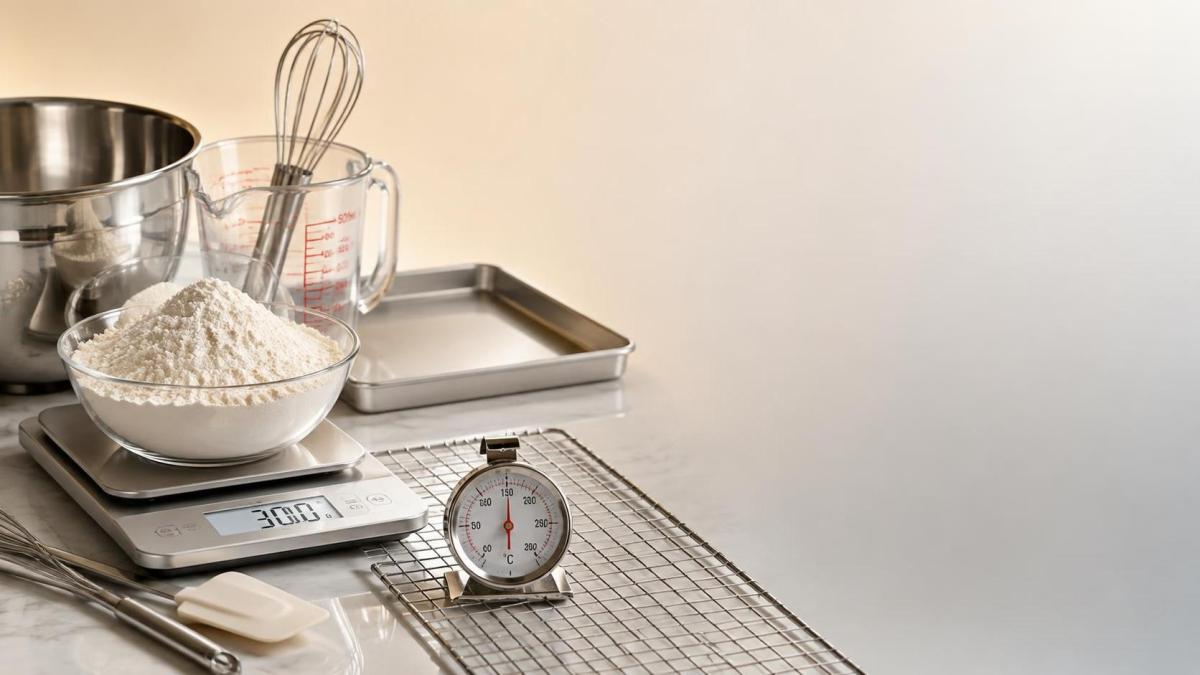
A digital kitchen scale is usually more useful than a large collection of measuring cups. It lets you weigh flour, sugar, butter, chocolate, and dough directly in one bowl, reducing both guesswork and cleanup. Look for a scale with a clear display, a stable platform, an easy-to-use tare function, and a capacity suitable for the batches you make. A compact scale is sufficient for cookies and cakes; frequent bread bakers benefit from one that can comfortably handle a large bowl of dough.
Measuring cups and spoons still matter, especially for small quantities such as baking powder, salt, vanilla, and spices. Choose sets with durable handles, clearly stamped markings, and spoon shapes that fit into standard spice jars. Avoid relying on decorative or unusually shaped cups if their markings are difficult to read or they cannot be leveled easily.
For liquid ingredients, a transparent measuring jug with high-contrast markings is more practical than opaque containers. It should include both common volume scales if you use recipes from different regions. Check the markings at eye level; a jug is only helpful if the scale remains readable after regular washing.
Mixing Tools Should Match the Texture You Make
Mixing is not one task. Creaming butter and sugar, folding whipped egg whites into batter, kneading bread dough, and stirring muffin batter all require different levels of force and control. Choosing the wrong tool can overwork a batter or leave heavy ingredients unevenly distributed.
Start with at least two mixing bowls: one medium bowl for everyday batters and one larger bowl for doughs, whipped cream, or double batches. Stainless steel bowls are light, durable, and easy to clean. Glass bowls are useful when you want to see the contents clearly and may be preferred for tasks involving a microwave, but they are heavier. A bowl with a broad base is less likely to slide while whisking, and a gently curved interior makes it easier to scrape down the sides.
A stand mixer is worthwhile when you make bread, meringue, buttercream, or larger batches regularly. Its value is consistency and reduced physical effort, not automatic better baking. Before choosing one, consider bowl capacity, available attachments, storage space, and whether the machine stays stable when working with stiff dough. A compact hand mixer can be the better option for occasional cakes, whipped cream, and small-batch cookies.
Do not buy a mixer solely based on motor power claims. Bowl shape, beater coverage, attachment quality, and how easily you can add ingredients during mixing have a more direct effect on day-to-day use. For delicate cake batters, a hand whisk and spatula remain important even in a well-equipped kitchen.
Bakeware Determines Shape, Browning, and Release
Good bakeware is selected by material, construction, and size, not by color or an oversized bundle. Your first pans should match the recipes you return to: a rimmed baking sheet for cookies and roasted nuts, a loaf pan for quick breads, a round cake pan for simple cakes, and a square or rectangular pan for bars and brownies.
Heavy-gauge metal pans heat more evenly than very thin, lightweight pans. Thin pans can warp when heated and may encourage darker edges before the center is ready. Light-colored aluminum or aluminized steel is often easier to manage for cakes and cookies because it gives a clearer visual signal of browning. Dark-coated pans can brown more aggressively, which may be useful for some recipes but requires closer attention to baking time.
Nonstick coatings make release easier, particularly for sticky bars and delicate cakes, but they should not be treated as permanent protection. Scratching the surface with sharp utensils or abrasive cleaning tools shortens useful life. If you prefer uncoated pans, parchment paper, a properly greased surface, and a well-fitted liner can provide dependable release without depending entirely on a coating.
Check the interior dimensions rather than assuming that all “standard” pans hold the same volume. A shallow pan spreads batter and bakes faster; a deeper pan produces a thicker layer that needs more time. Switching pan size without adjusting expectations is a common reason for underbaked centers, dry edges, or cakes that sink after removal from the oven.
Silicone, Glass, and Metal Are Not Interchangeable
Silicone molds are flexible and useful for muffins, small cakes, chocolates, and frozen desserts. Their flexibility can make removal easy, but soft molds need a firm baking sheet underneath for safe transfer. They also tend to brown differently from metal, so they are less predictable when a crisp edge is part of the goal.
Glass and ceramic dishes retain heat longer than metal. They work well for baked puddings, cobblers, casseroles, and recipes meant to be served in the same dish. They are less convenient when a recipe depends on quick heat transfer or crisp corners. Use the material specified by a recipe when possible, especially while learning it.
Temperature Tools Prevent More Failures Than Fancy Gadgets
An oven dial is an instruction, not always a precise reflection of the heat surrounding the food. If cakes repeatedly brown too quickly, cookies spread unexpectedly, or bread crusts set before the center has developed, temperature control deserves attention before you replace ingredients or buy new pans.
An oven thermometer gives you a direct view of the oven environment and can reveal whether the displayed setting and actual heat differ. Place it where the food usually sits, allow the oven to fully preheat, and observe whether the temperature remains steady during baking. This is especially useful in older ovens or compact countertop ovens, where heat can vary significantly across the chamber.
An instant-read thermometer is another high-value tool, particularly for bread, custards, cheesecakes, caramel, and baked goods with fillings. It should have a narrow probe, a display that is easy to read, and a design that can be cleaned thoroughly. It does not replace visual cues, but it helps when appearance alone cannot tell you whether the interior is set.
A timer should be simple enough to use every time. Many baking problems come from relying on memory while preparing other dishes or cleaning up. Use recipe timing as a checking window rather than an automatic finish line. Pan material, oven behavior, batter depth, and ingredient temperature all influence the final minutes.
Buy by Baking Pattern, Not by Aspiration
A beginner who mainly makes cookies and simple cakes does not need a proofing basket, specialty piping tips, multiple tart rings, or a large bread mixer. Those items become useful when a technique becomes regular enough that improvising is frustrating or inconsistent.
For cookies and tray bakes, prioritize a scale, mixing bowls, silicone spatula, whisk, sturdy baking sheets, cooling rack, parchment paper, and timer. Cooling racks are often overlooked: leaving cookies on a hot pan continues the baking process and can make the bottoms too firm.
For cakes, add matching cake pans, an offset spatula for frosting, a fine mesh sieve for dry ingredients when recipes call for it, and a reliable thermometer. Choose pans with straight sides when appearance matters; sloped sides are harder to stack and frost evenly.
For bread, add a dough scraper, a large bowl or dough tub, a sturdy loaf pan or baking surface, and a thermometer. A bench scraper is small but useful for dividing dough, lifting sticky dough from the counter, and cleaning flour and residue without damaging the worktop.
For pastry, choose a rolling pin that feels balanced in your hands, a pastry blender or food processor if you make pie dough often, and a set of cutters only when you use their shapes repeatedly. Precision matters, but storage matters too. Tools that are difficult to reach, clean, or store tend to remain unused.
Features That Matter During Daily Use
Before buying, examine the places where tools usually fail: handles, joins, rims, markings, moving parts, and coatings. A loose handle, a cracked silicone head, a warped sheet pan, or fading measurement marks creates frustration long before the main body of the tool wears out.
- Cleaning: Prefer smooth surfaces and accessible corners. A tool that traps batter or grease is harder to keep pleasant and hygienic.
- Storage: Measure drawer depth, cabinet height, and oven space before buying stacked pans, mixer attachments, or bulky appliances.
- Heat limits: Confirm that spatulas, mats, and handles are intended for oven or stovetop heat if that is how you plan to use them.
- Replacement parts: For electric mixers and specialty appliances, access to bowls, beaters, lids, and seals can be more useful than extra preset functions.
- Comfort: A handle that feels secure when your hands are wet or flour-covered is safer than one chosen for appearance alone.
It is also sensible to avoid filling a drawer with single-purpose gadgets. An adjustable measuring spoon may seem space-saving but can be awkward with sticky ingredients. A basic set of individual measuring spoons is often faster to use and easier to wash. In the same way, a sturdy spatula and scraper usually provide more value than several novelty batter dispensers.
A Practical Buying Order
If your current setup is limited, buy in the order that improves accuracy and repeatability first: digital scale, measuring spoons and jug, two durable bowls, whisk and silicone spatula, baking sheet or pans suited to your recipes, cooling rack, and oven thermometer. Add a hand mixer or stand mixer only when manual mixing is limiting the recipes you want to make.
Then make one test recipe after introducing a new pan or appliance. Keep the recipe, rack position, and ingredient quantities consistent. This shows how the tool behaves in your own oven and makes it easier to adjust future baking. Better results usually come from a small group of dependable tools used with attention, rather than from a crowded collection of equipment.
Popular Tags
Kitchen Industry Research Team
Dedicated to analyzing emerging trends and technological shifts in the global hospitality and foodservice infrastructure sector.
Industry Insights
Join 15,000+ industry professionals. Get the latest market trends and tech news delivered weekly.
No spam. Unsubscribe anytime.
Hot Articles
 Choosing Commercial Cooking Appliances for Your Menu and Peak Service Demand
- Choosing Bakery Equipment for a Small Bakery: Capacity, Space, and Budget
- How to Choose Glass Office Decor Vases That Enhance Reception and Meeting Spaces
- How to Choose Ceramic Serving Plates for Restaurants, Catering, and Banquet Service

Contact With us
Contact:
Anne Yin (Ceramics Dinnerware/Glassware)
Lucky Zhai(Flatware)